
October. 10th & 13th, 2023
Western Front
7:30pm & 6:00pm
Bone Deep Deliverance (SCREAM II) is a continuation of Samra Mayanja’s prior sound piece SCREAM, vocalized by a Black experimental choir in 2020. For Bone Deep Deliverance (SCREAM II), Mayanja explores engulfment through both performative and sonic means, which she describes is like:
“telling a joke
about a secret sky
that can’t be told otherwise.”
Description
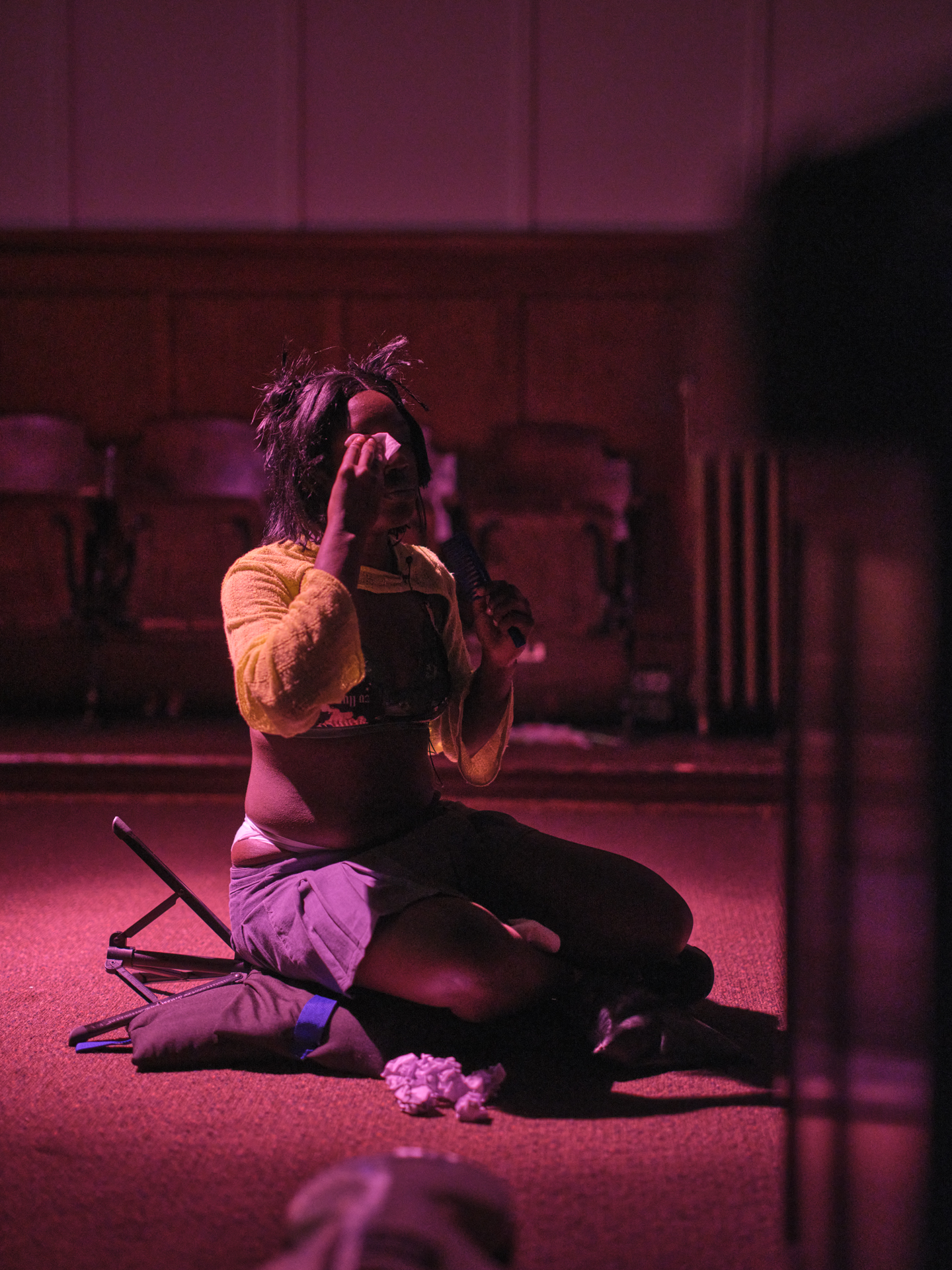
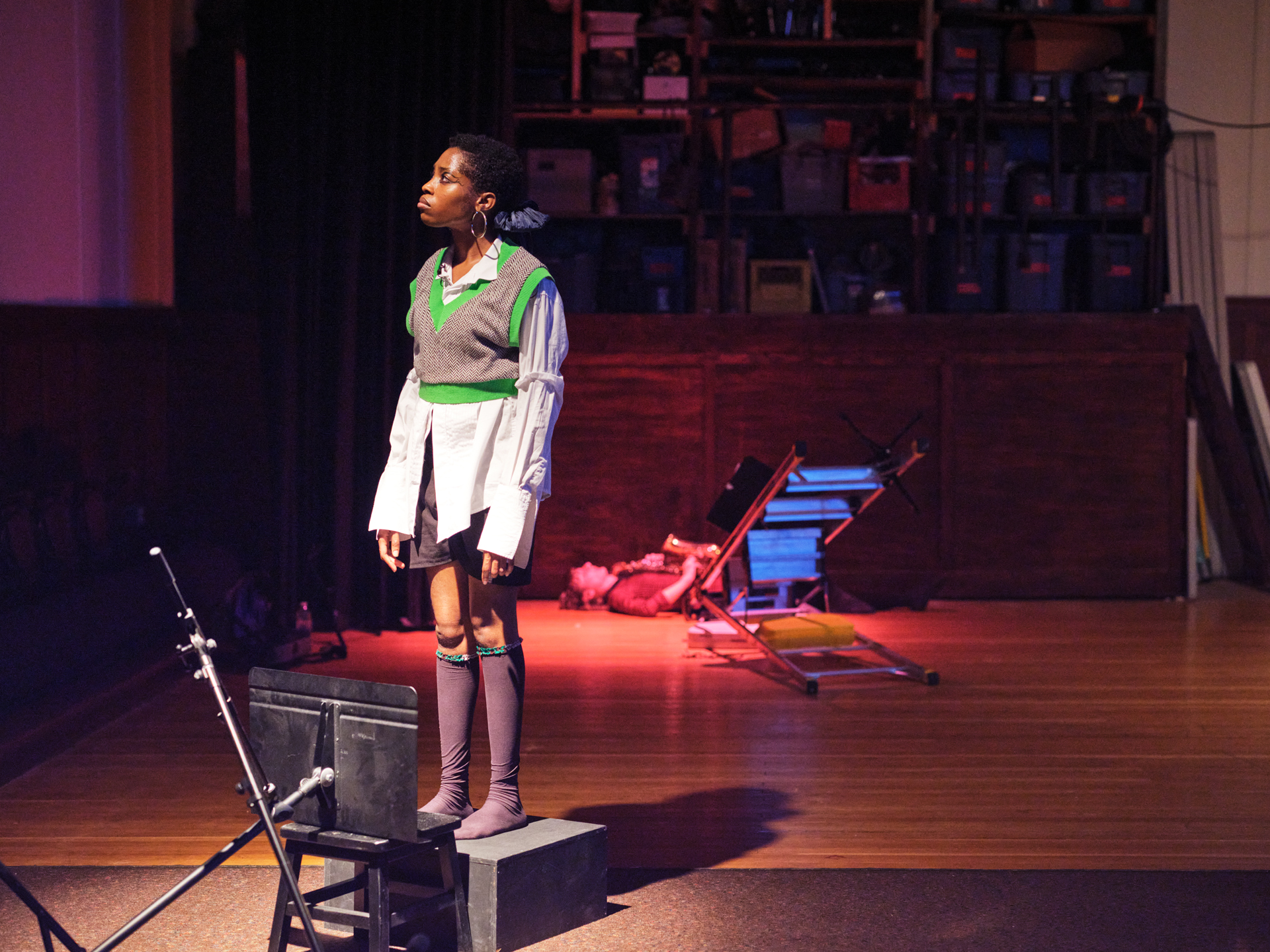
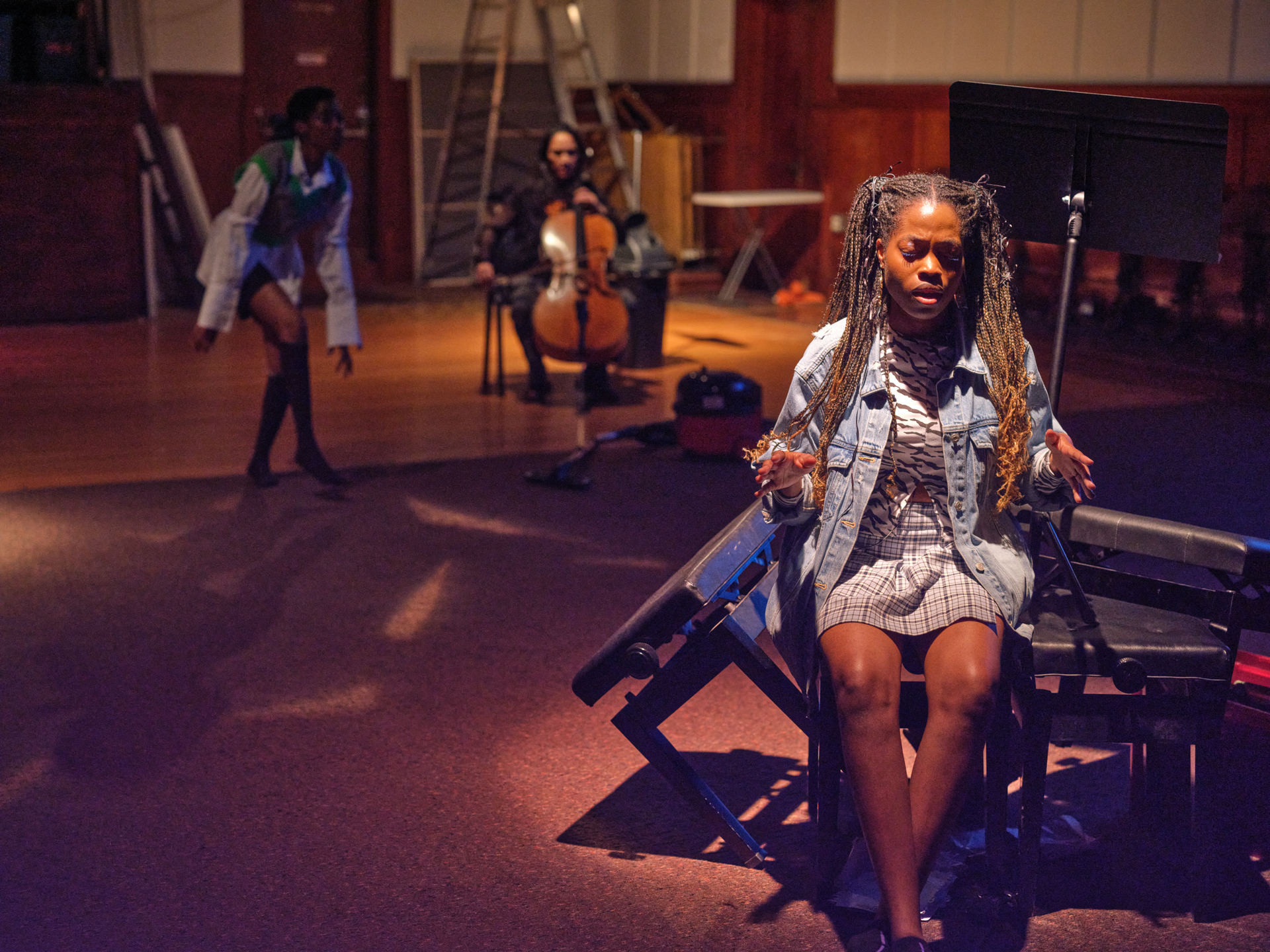
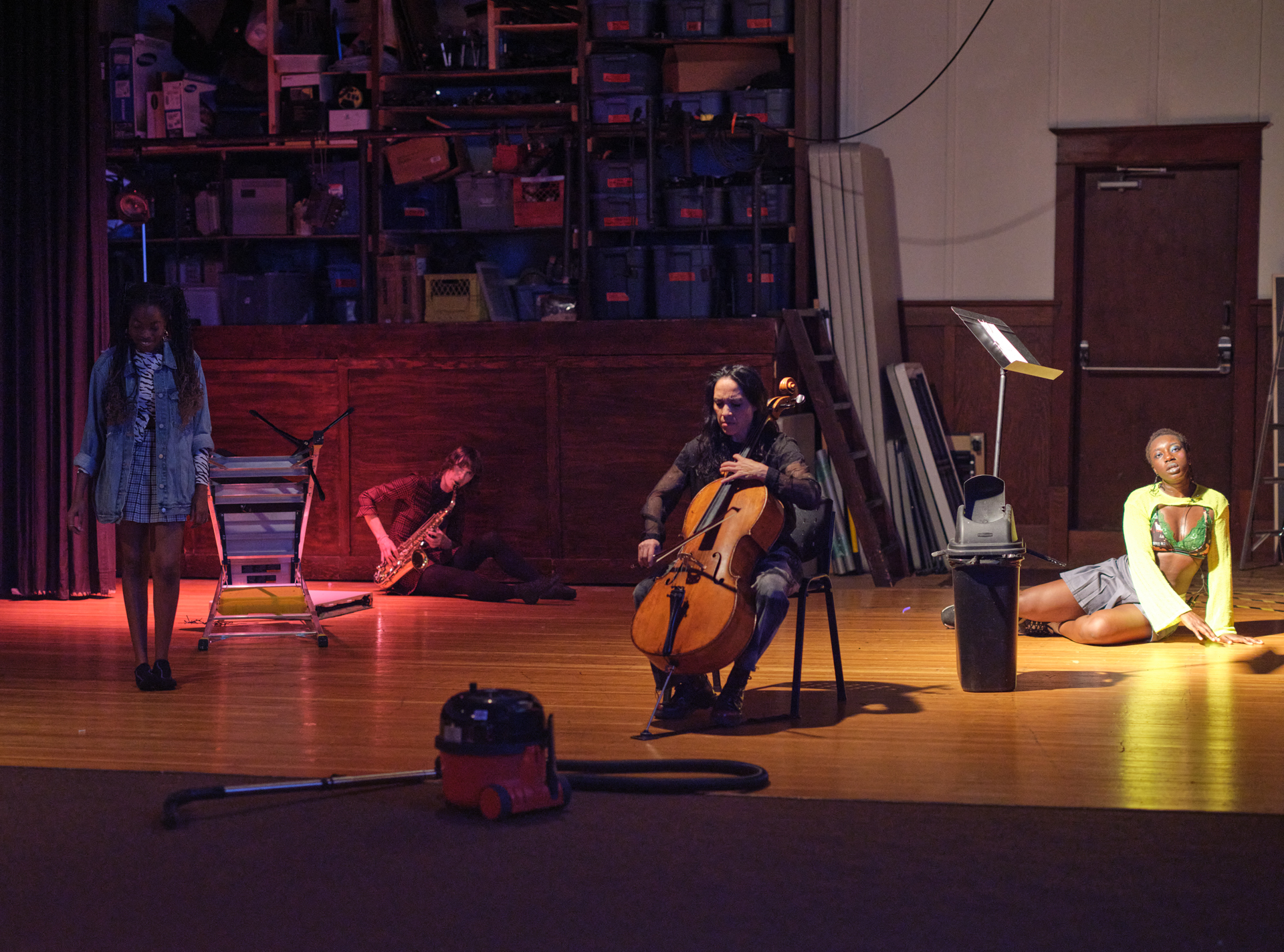
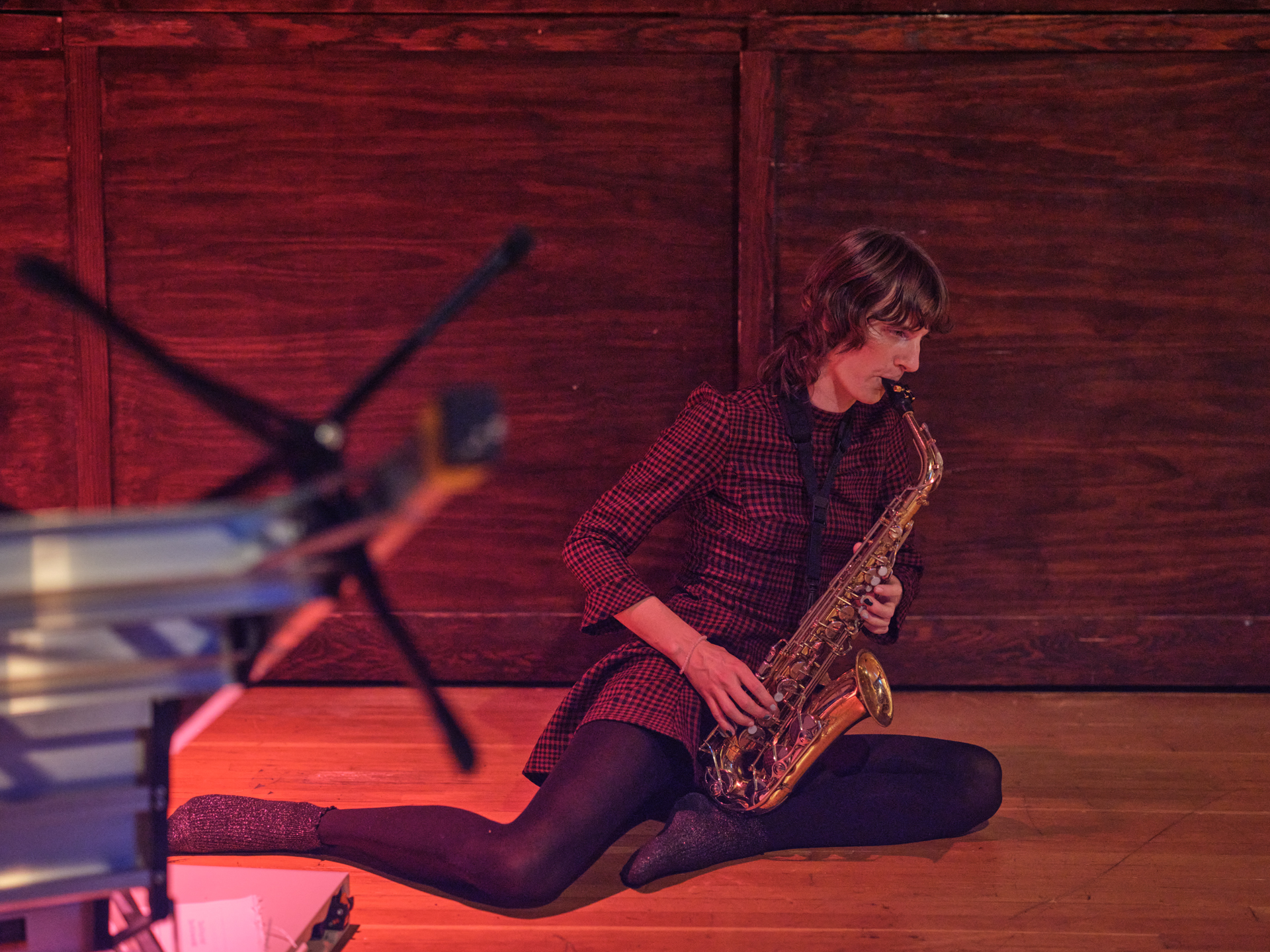
To begin, the performers led audience members to their seats one at a time, handing each a program: a crumpled piece of paper in the shape of a heart with a brief handwritten message on it. Dispersed around the dimly lit room, set up in the round, were groupings of objects sourced from around Western Front. An arrangement of piano benches became Cellist Peggy Lee’s performance space; a podium of piled stools and microphone stands was Oluwasayo Olowo-Ake’s (Sayo) stage; Oluwasola Olowo-Ake’s (Sola) singing station was a garbage can music stand; and the floor to ceiling curtains at the back of the room became saxophonist Andromeda Monk’s arena. As the audience filtered in, Mayanja sat on her knees near the entrance softly humming while tenderly combing her wig and wiping her face.
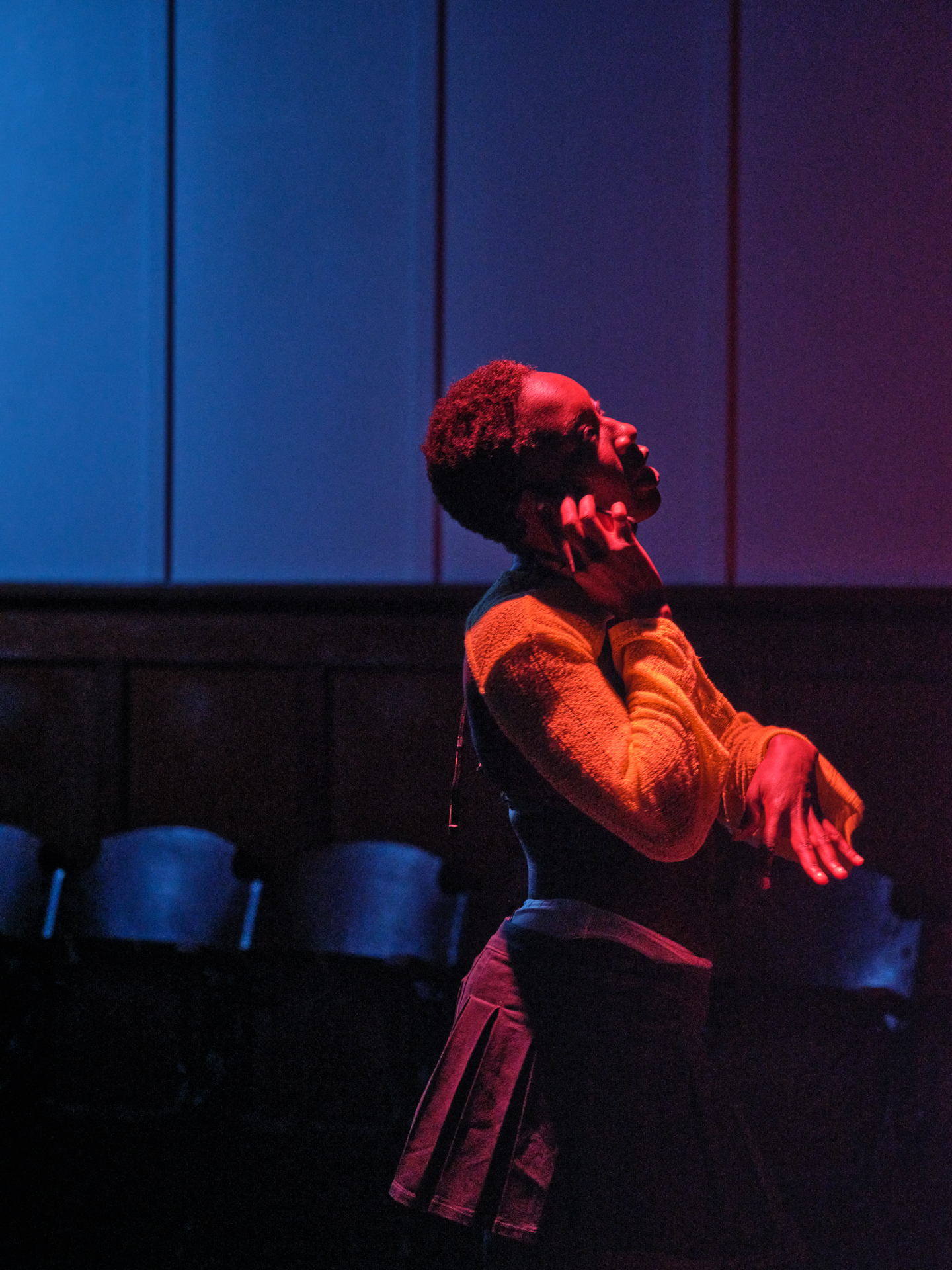
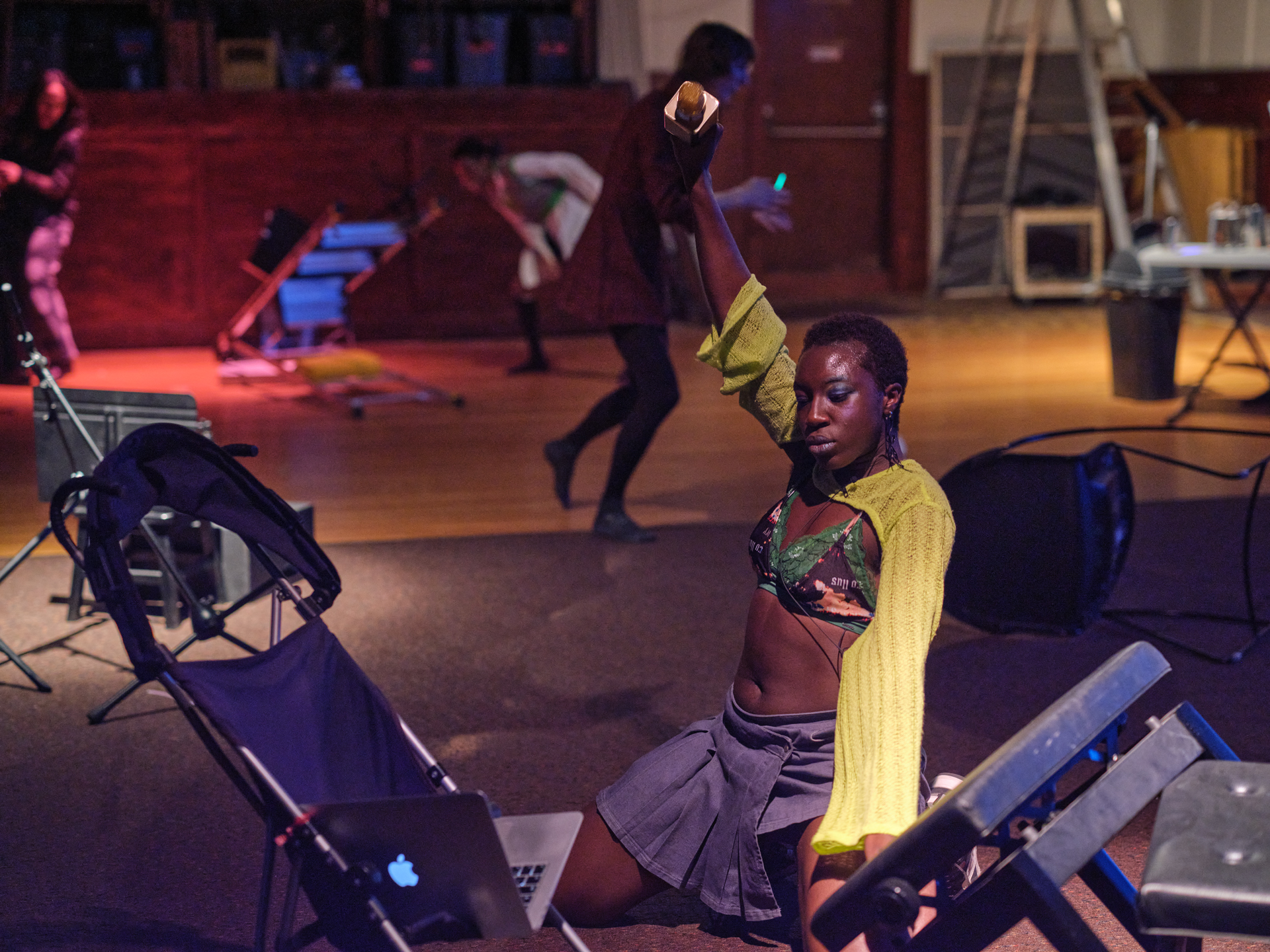
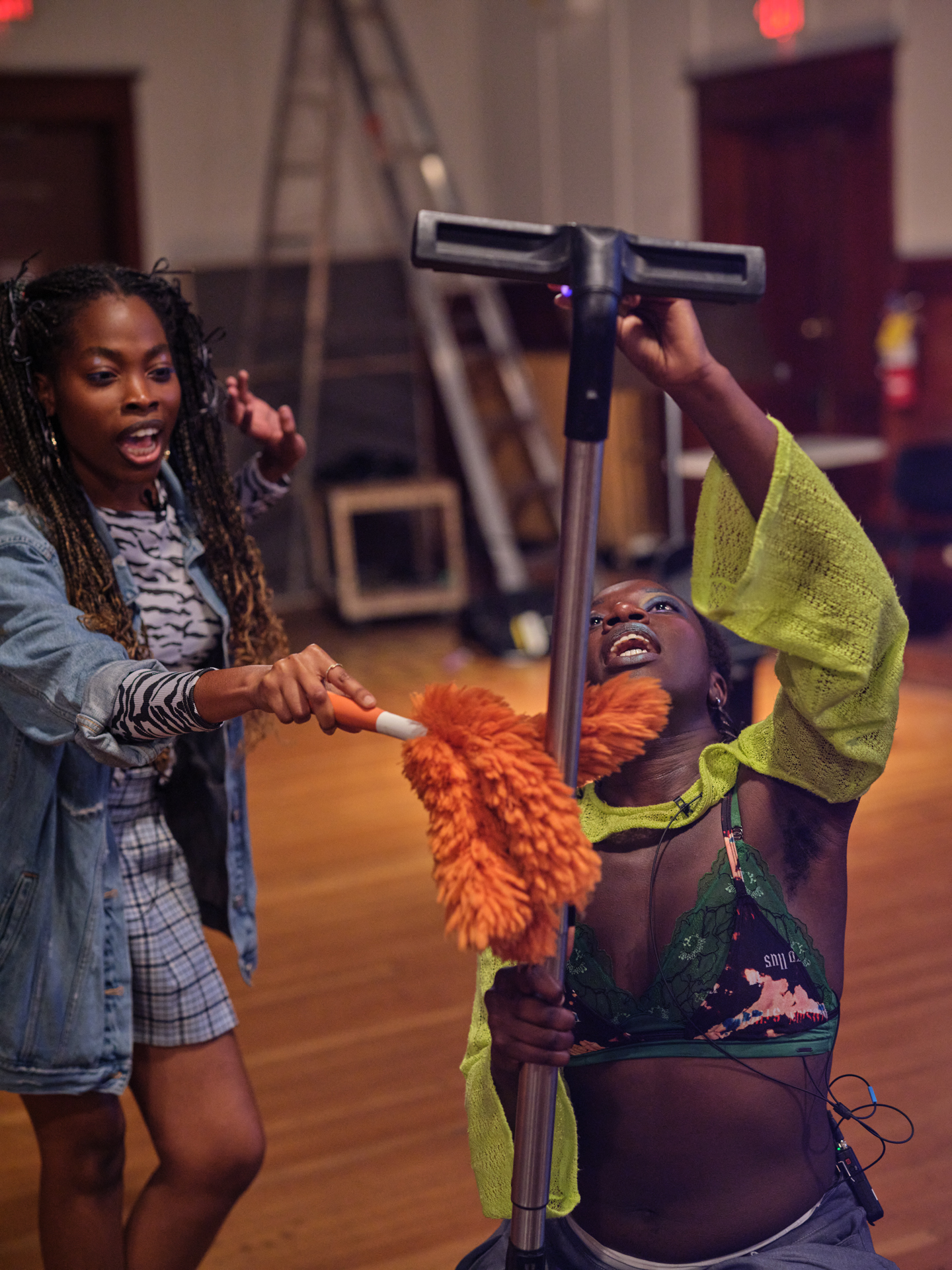
Utilizing movement and sound-based scores throughout Bone Deep Deliverance (SCREAM II), Mayanja, Monk, Lee and the Olowo-Ake sisters played with performance art’s capacity to disrupt, evoke, affect and interpellate. At one point in the piece, Mayanja received a phone call which got projected through the loud speakers; a cadence of calculated groans and silences navigated this public/private conversation. Later, she re-entered the room wheeling a laptop strapped in to a child sized umbrella stroller. As Mayanja began reading the Karaoke lyrics from the roving screen, Lil Wayne’s “A Milli” (2008) resounded through the room. At this point, the performance became a party: Monk and Lee tossed glow sticks and paper airplanes around the room, Sayo performed choreography and Sola shook gimlets at a pop-up bar. Then, after a theatrical interjection from LIVE Biennale Director Derrick Chang, the energy shifted and the performers began chanting in unison “I do what I do, and you do what you can do about it, can do about it” while cleaning up the space. The 50-minute long performance culminated with the performers falling into a collective laughing fit. Directed towards each other and perhaps at the audience as well, they giggled and howled while cyclically leaving and re-entering to the room.
Bone Deep Deliverance (SCREAM II) was an expansion of a sound work and text composed and written by Mayanja in Leeds, England. Exhibited at MaMA, Rotterdam, with vocalists Banana and Orange, and pianist Rev Chunky, this work featured sound design by Mayanja and Liza Violet, costumes by Margaret Zawede, dramaturgy by Malik Nashad Sharpe, and collaborative support from Herfa Martina Thompson, Munesu Mukombe, Dee Byrne, and Meera Priyanka.
Performers
Peggy Lee (Cello), Samra Mayanja (Composer, Writer, Performer), Andromeda Monk (Alto saxophone), Oluwasayo Olowo-Ake (Sayo) (Vocals), Oluwasola Olowo-Ake (Sola) (Vocals), and Derrick Chang (LIVE Biennale Director)
Review of Samra Mayanja’s Bone Deep
Deliverance (SCREAM II)
by Amy Ching-Yan Lam
December 2023
“telling a joke / about a secret sky / that can’t be told otherwise."
                                                                                 —Samra Mayanja
To get to a seat for Samra Mayanja’s performance Bone Deep Deliverance (Scream II), we have to avoid Samra herself, who’s sitting on the floor close to the threshold of the performance space, wig askew, singing. One of the other four performers leads us, one by one, into the rectangular room, where two rows of chairs face each other, lining the two long walls. This seating management means that we’re all separated from the friends that we came to see the performance with. Maybe as a form of consolation, on our way in we’re given small, crumpled, heart-shaped pieces of lined paper. They look like secret notes passed in a classroom. Afterwards, my friend shows me theirs, which reads: “Don’t look your elders in the eye.” The space itself is in disarray with the equipment needed to produce the performance scattered all around—a music stand jammed into a garbage can, another music stand on its side, the back wall exposed with shelves of plastic storage boxes. Everything seeming like it’s in the middle of an action or process.
Samra has described her series of Scream performances as a “Black experimental choir” that investigates different modes of performing: the type of performance that one does in everyday life (as a competent worker, or as an obedient child); the performance one does as an artist, on stage; and the experience of being engulfed by performance—of collapsing into a moment. One of the first things that Samra says in the performance to the other performers—two musicians (Peggy Lee on cello and Andromeda Monk on sax), and two vocalists (Oluwasola Olowo-Ake and Oluwasayo Olowo-Ake, twin sisters)—is a direction for their improvisation: “Alright, let’s keep it fun, let’s keep it jovial…Light!!!…Let’s keep it cute!!!” And then she leaves the room for a bit.
It’s not clear how seriously the performers take her opening command: the music and vocals over the hour-long performance range from cacophonous to elegiac, with recurring phrases like, “I don’t want to speak English.” Things that you might say to yourself when you’re not allowed to say them to anyone else. The mood is of defiance more than cuteness, and the performance refuses to settle into any one mode. Elements loop and repeat, but the whole constantly switches.
This rhythm of self-interruption is expressed not only in Samra’s performed authority as the leader of the group, but also in the appearance of Derrick Chang—the Director of LIVE Biennale, the ultimate arbiter of the performance space—playing himself. At one point, the improvisation settles into a mournful, beautiful refrain of “Rest little child,” but Derrick suddenly stands up out of the audience with a command for everyone to do karaoke together. It’s time to keep it light again!
The party scene that ensues is chaotic with a laptop playing a karaoke video in a baby stroller being pushed around the room by Samra, a make-shift bar that no one drinks from, and glow sticks being thrown around. The forced party doesn’t feel that fun, as the majority of the people in the room are seated and watching from the sidelines. The Lil Wayne song “A Milli” dominates, and the performers repeat one of its aphorisms: “I do what I do, and you do what you can do about it,” until it becomes oppressive. Derrick the Director then comes back to crash the party, with the order: “This is a mess!! This is not appropriate for a performance!! Clean this up right now!!!” This makes me laugh: both at the authoritative voice mimicking authority, and at the truth of an authority telling you to do one thing, and then the opposite thing shortly afterwards.
At the end of the performance, after the performers’ voices and music have looped through various ranges of intensity—from barely audible to silencing, coming in and out of sync with each other, demonstrating both their virtuosity and openness—they leave the room together laughing, and then come back into the performance space again, laughing, very loud and uncontrollably, doubled over. They are laughing so hard, and the audience is not laughing, so there’s the implicit fact that they are laughing at the audience, or that they’re laughing at something they know that’s unknown to the audience, which makes the audience worthy of being laughed at. A soundtrack of a kind of general din plays in the background, like we’re in a loud public space, not a contained performance. The performers leave the room again, and the audience still sits there, quiet, for many uncomfortable moments, and then the performers enter again, laughing, completely consumed in their laughter, not looking at the audience, but totally wracked by laughter. There is no clear moment where the performance ends, just this laughing, feeding on itself, seemingly unstoppable.
~
In the weeks after seeing Bone Deep Deliverance (Scream II), I’ve been thinking about laughter, and wondering, what is it? Like, actually: what is laughter? What is this weird sound and embodied action? Other emotions also create physical responses: crying, sobbing, the lovely phenomenon of tears, or screaming caused by fear and pain. These ones seem easier to understand in purely utilitarian terms: crying, to ask for consolation and comfort; screaming, to be alerted to danger, and to urgently call for help.
Laughter is much more ambiguous—it can be hostile but also social, it can be used to hurt as well as to bond with other people. Failing to make other people laugh is especially embarrassing, or worse, if the joke is received as hurtful. Almost all of my relationships are based on being able to laugh together. Once during a psychic reading, after the psychic assured me that I would find a boyfriend, I asked immediately, “Is he funny?” She responded with, “He takes his work very seriously.” And she was right: my partner is both very funny and takes his work very seriously. In some ways, having a sense of humour means taking things very seriously, because you need to be paying attention enough to find the funny details.
In preparation for this writing, I read an article in the Personality and Social Psychology Review, “What Makes Things Funny? An Integrative Review of the Antecedents of Laughter and Amusement,” to try to understand it from the perspective of research science. The authors of the article attempt to break down all of the necessary conditions to make something funny, and after comparing all the various theories of humour, of which there are many (though limited by the fact that most come from WEIRD [Western, Educated, Industrialized, Rich, Democratic] cultures), they narrow it down to three conditions: that there’s an aspect of “simultaneity,” a juxtaposition of different or contrary things happening at the same time; a “violation appraisal,” some kind of violation of a normative or perceived order; and a “benign appraisal,” that what’s happening isn’t actually dangerous. The article also says that:
Three pieces of evidence suggest that laughter is a primitive form of communication. One, laughter develops before speech. Babies laugh before they talk, and apes, dogs, and arguably even rats can laugh. Two, laughter occurs primarily in social settings. Apes, children, and grownups are all more likely to laugh when near others than when alone. Three, laughter is universally recognizable. Even if people do not speak the same language, they can recognize when another person is laughing.1
So laughter is foundational and universal, but also only occurs when a complex situation can be parsed. Something absurd, maybe toeing the line of what’s threatening, but that can be resolved through a shared understanding. Obviously, not all people laugh at the same things; what people find funny mostly depends on their values, the way they see the world. And maybe that’s the “purpose” of laughter (if one is needed): it exists not only to help you find others like you, but to help you define your values in relation to others.
In the past seven weeks since Samra’s performance, the assault on Gaza and on Palestinian people has torn the masks off the Western world, off the ideals of “human rights,” “international law,” “freedom of speech.” These ideals have been revealed, more than ever before, or at least within my lifetime, to be total shams. The hypocrisy and the ensuing cognitive dissonance—the violation and the simultaneity—have been overwhelming. Every day is bracketed by watching videos of children and babies being maimed, crushed, killed, while also filled with deafening silence and seeming indifference from many people I know, either because they actually don’t care, or because they want to keep their jobs and careers. It’s hard to tell which reason is worse. One of the few times in the past month that I laughed really hard at a piece of popular media was when I watched a video made by a Jewish activist, Rafael Shimunov, making fun of the Israeli Offence Forces (IOF)2: he went around an apartment, pretending to be an IOF officer, pointing at everyday objects like a painting of Lana Del Rey and a garbage can, explaining matter-of-factly how they were actually objects of terrorism and needed to be bombed. “This is a garbage that lifts up, when you press the thing. It lifts up, it’s a Hamas garbage, it lifts up, like uprising, in Arabic it’s intifada. This intifada garbage. […] We will be bombing this tomorrow.”3 I laughed my ass off; he reduced the IOF to the essential truth of its absurdity. I can imagine even rats laughing at that joke. In a way, it’s easier to imagine animals laughing at that joke than other humans, because other humans are driven by profit and the things that can be gained by supporting or remaining complicit in the Israeli occupation. So laughter has the strange power to divide, or reveal division, while at the same time it can make one feel a bit better or lighter. Laughter is true medicine in the sense of also being a type of clarifying poison. It’s not a panacea, it’s powerful because it requires specificity.
Samra’s dedication for her Scream performances reads: “To my family (chosen and blood) and to those impacted by state violence and carceral systems worldwide.” And so why does it end in laughter? A laughter that’s not shared, that prevents the audience from participating in the social rite of clapping for the performers, whether the audience actually believes in celebrating them or not? A painful kind of laughter, awkward, but one that engulfs the performers? Not as authentic as a scream, not nearly as emotionally clear.
Like the commands to “Keep it fun!” or to “Clean this mess up!,” the concluding laughter interrupts the performance of the performance. It severs the illusion held between the performers and the audience. It demands: in a carceral, colonial world, do we experience anything collectively? Do we actually share anything in common? Do we actually have any values we share? Do we abide by the same authorities? Do we give our power to the same authorities?
If so, prove it. I need you to prove it.
- Caleb Warren, Adam Barsky, and A. Peter McGraw. “What Makes Things Funny? An Integrative Review of the Antecedents of Laughter and Amusement.” Personality and Social Psychology Review 2021, Vol. 25 (1) 41–65. 55. ↩︎
- IOF is the colloquial version used by Palestinian resistance supporters. Officially named the IDF (Israel Defence Forces). ↩︎
- @rafternoon. “Israeli soldier exposes Hamas across hospitals and apartments in Gaza.” Instagram video. November 14, 2023. https://www.instagram.com/reel/CzoMvXPu3zp/?utm_source=ig_web_copy_link&igshid=MzRlODBiNWFlZA%3D%3D ↩︎