
October. 15th, 2023
Russian Hall
7:00pm
The Energy Never Dies (The E.N.D.) is an interdisciplinary exploration bracketed within a dance cypher. Joshua Ongcol, the creative director of The E.N.D., facilitates a collaboration between music and dance which relies upon structures of giving and receiving that exist within this circular dance formation. For this performance, the musicians and dancers contemplate patterns, cycles and rhythms while leaning into ongoing improvisation. Fuelled by the exchange of creativity and energy between performers, community and audience, The E.N.D. asks all those present to contemplate and embody the socio-cultural tethers that continually connect us to one another.
Description
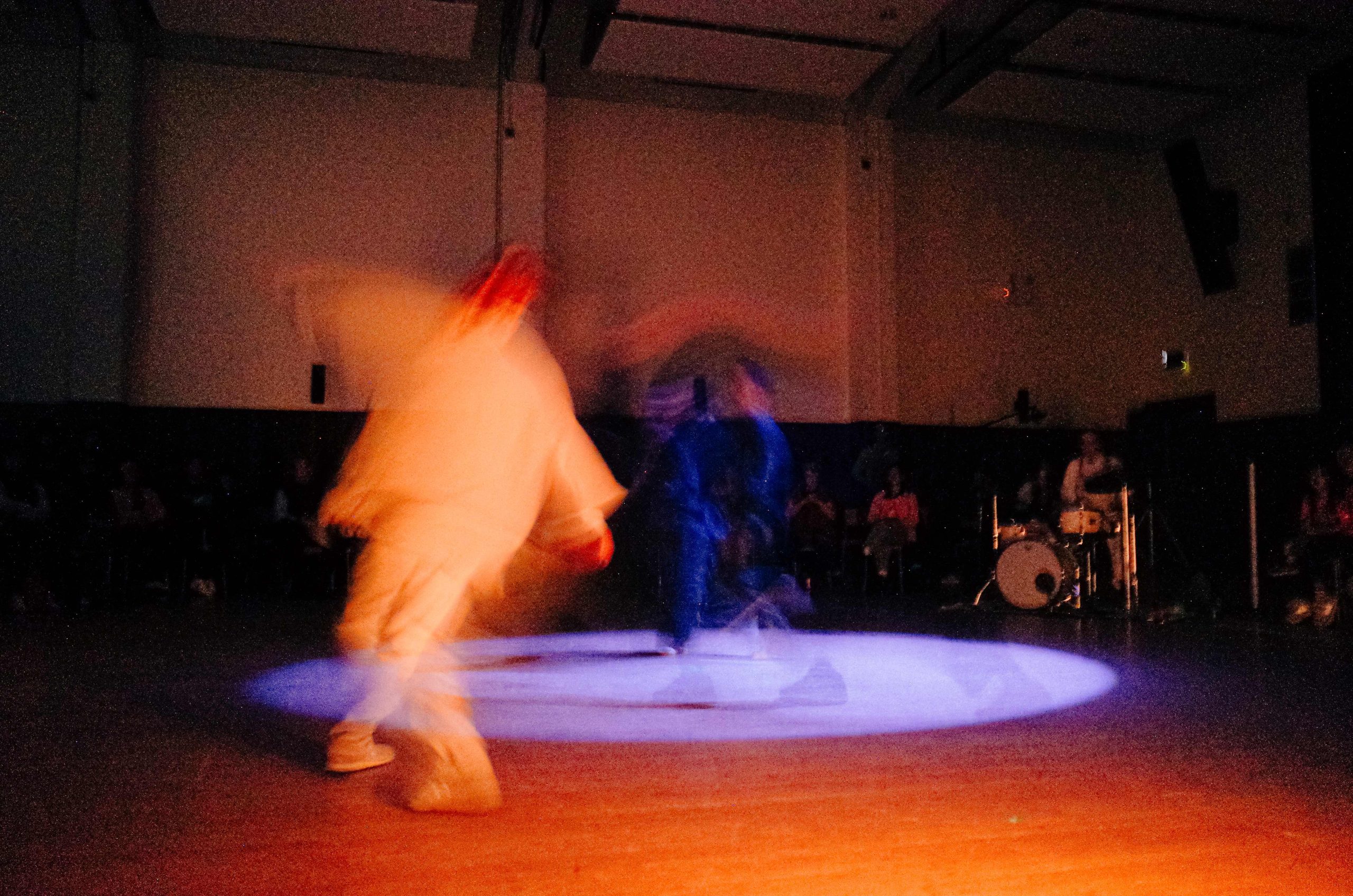
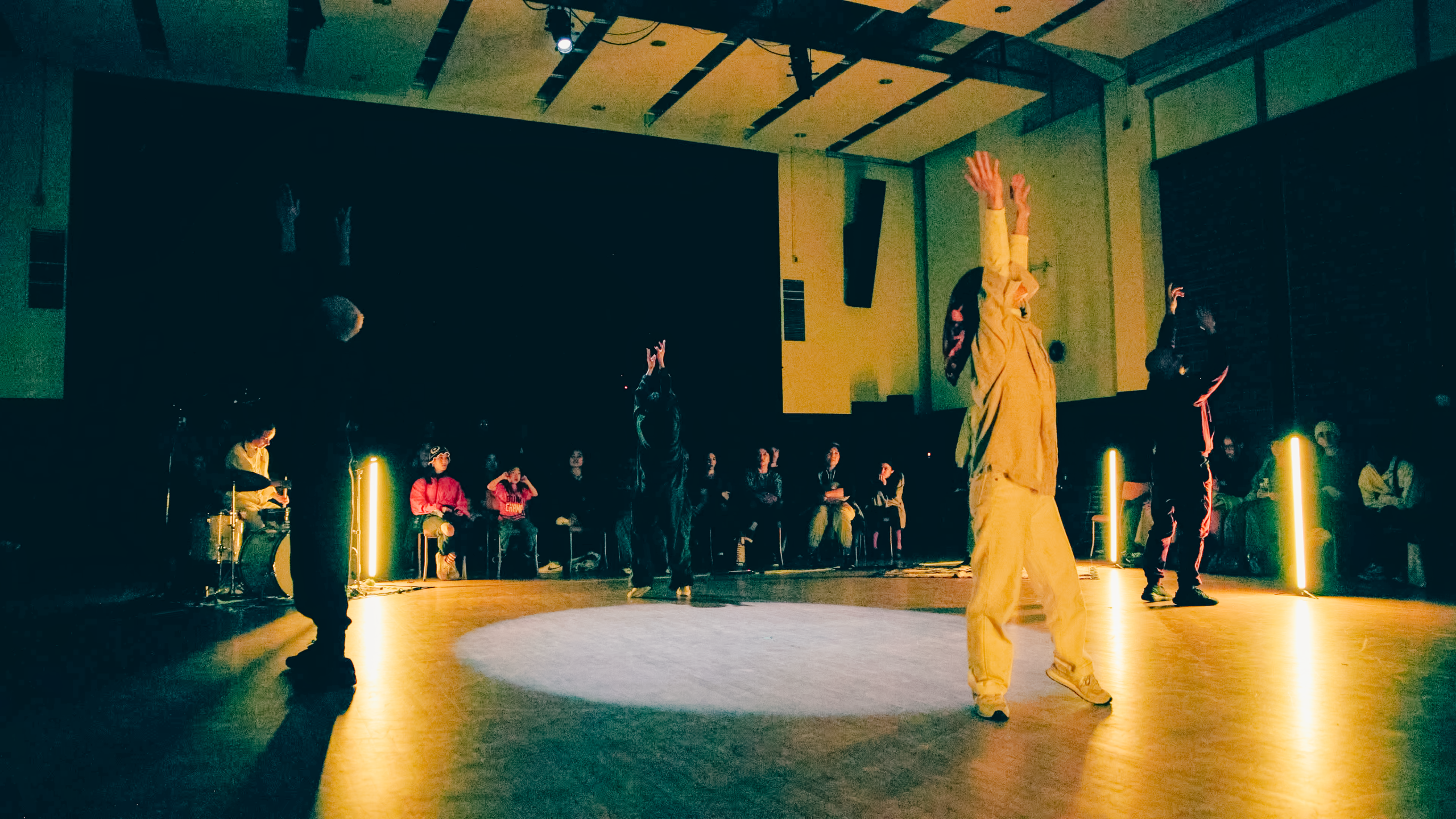
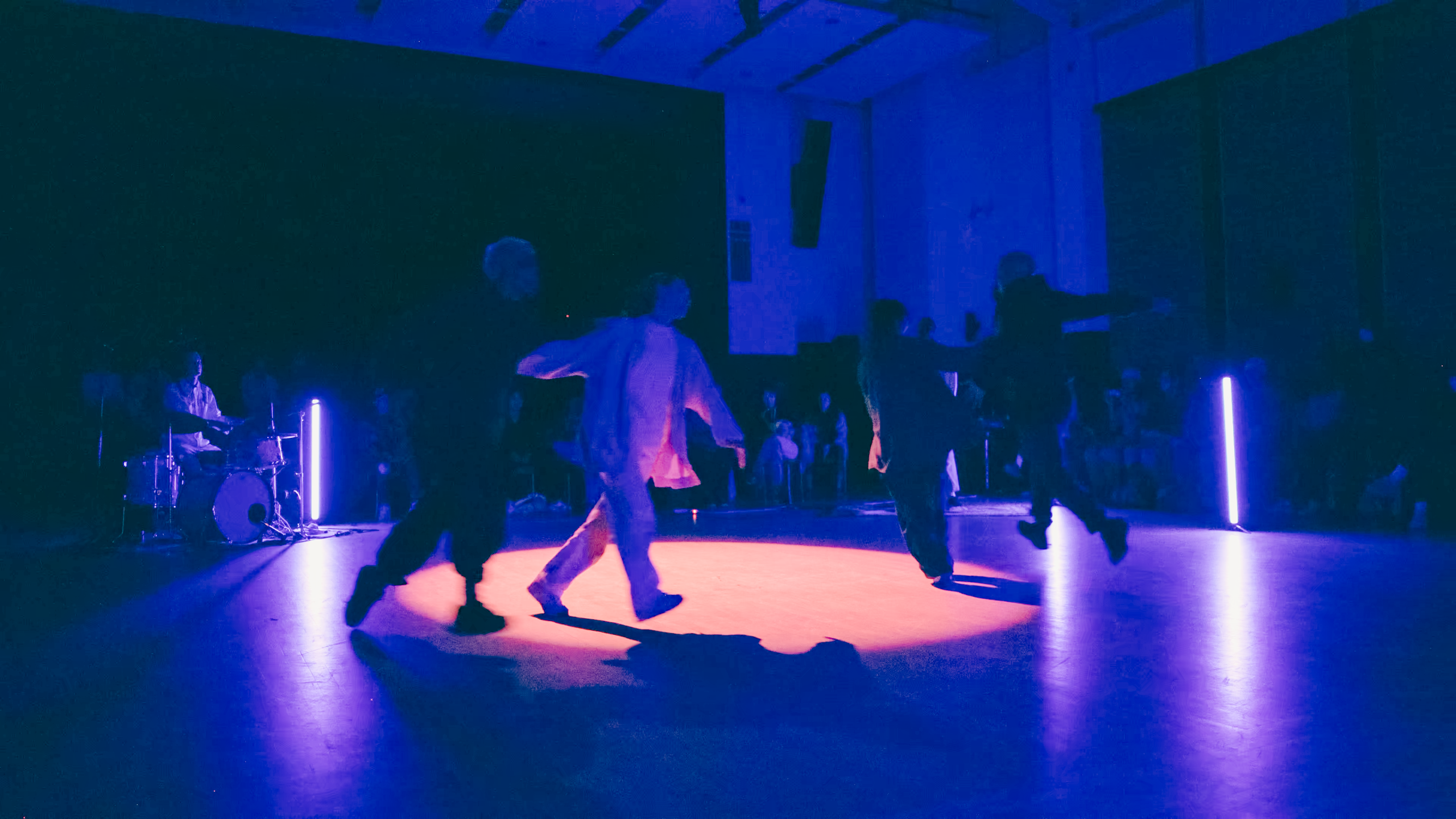
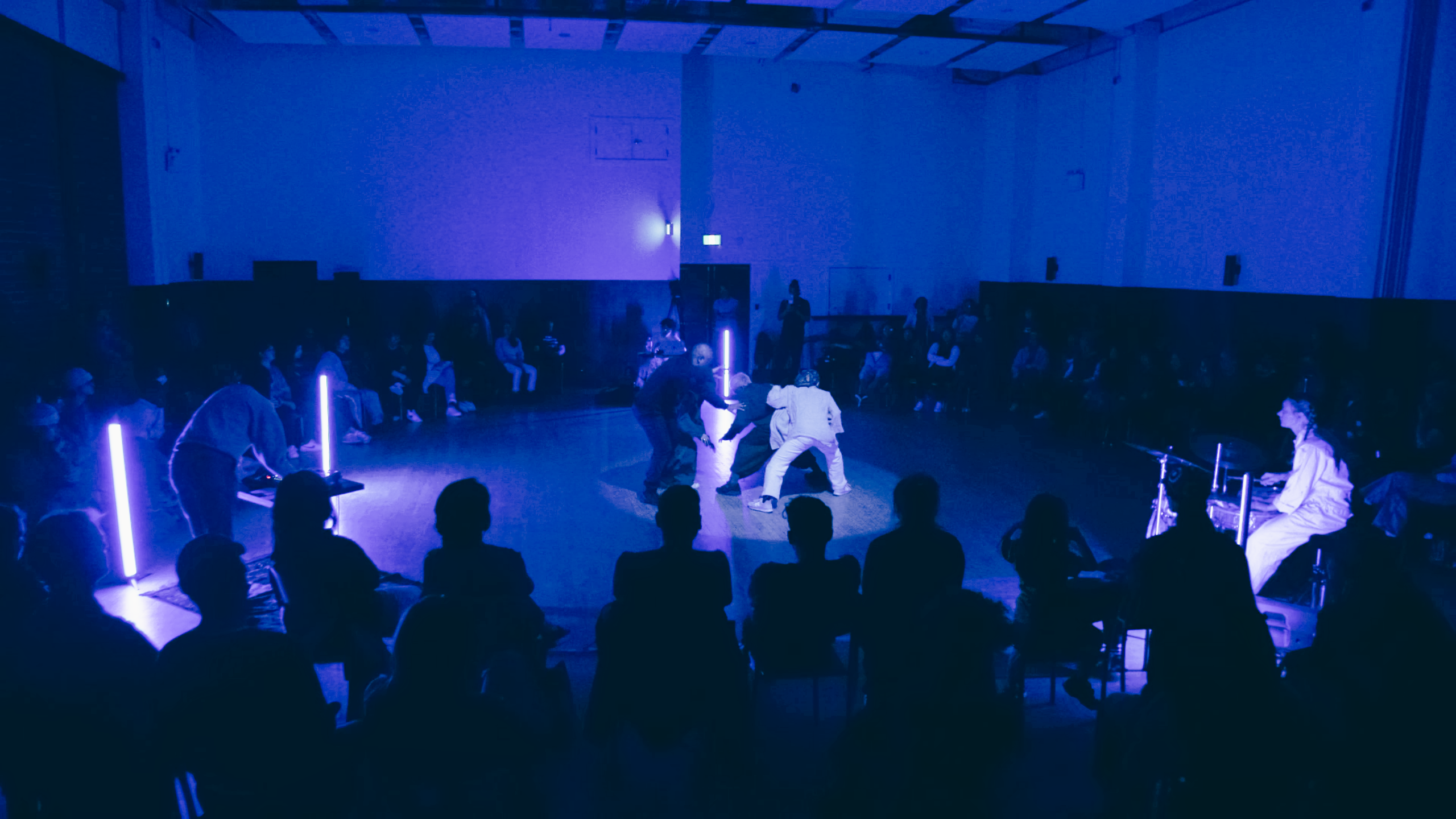
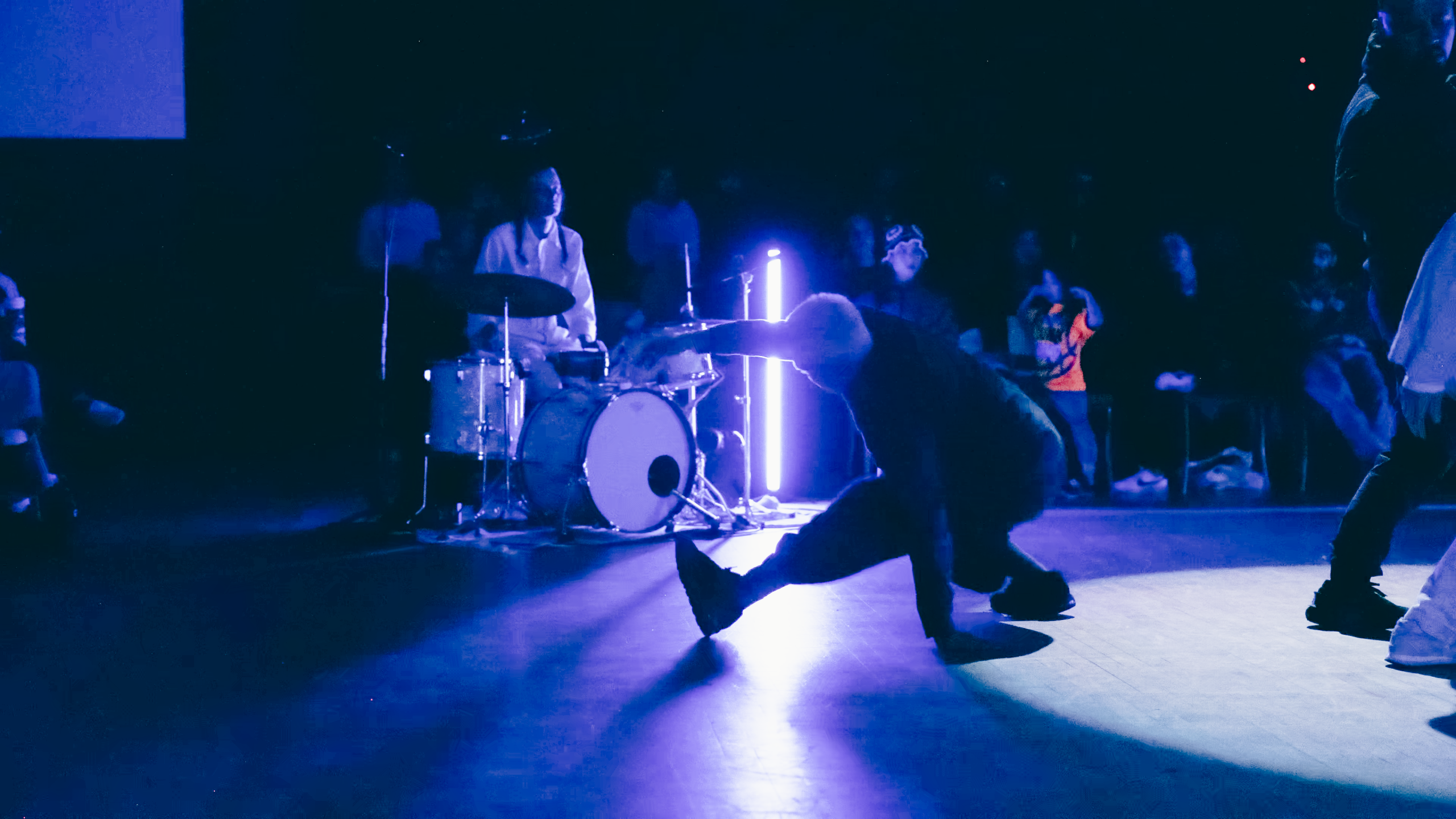
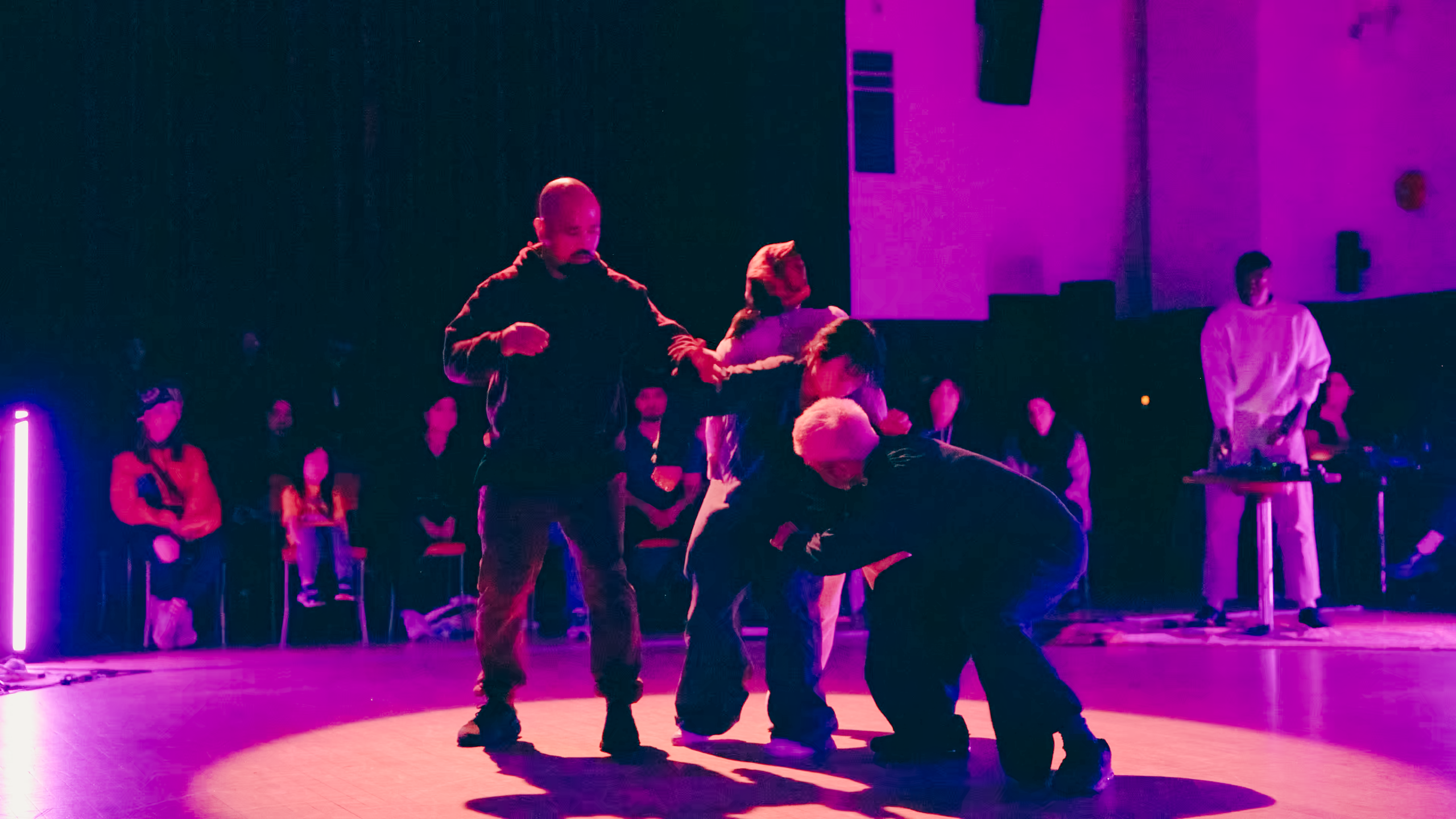
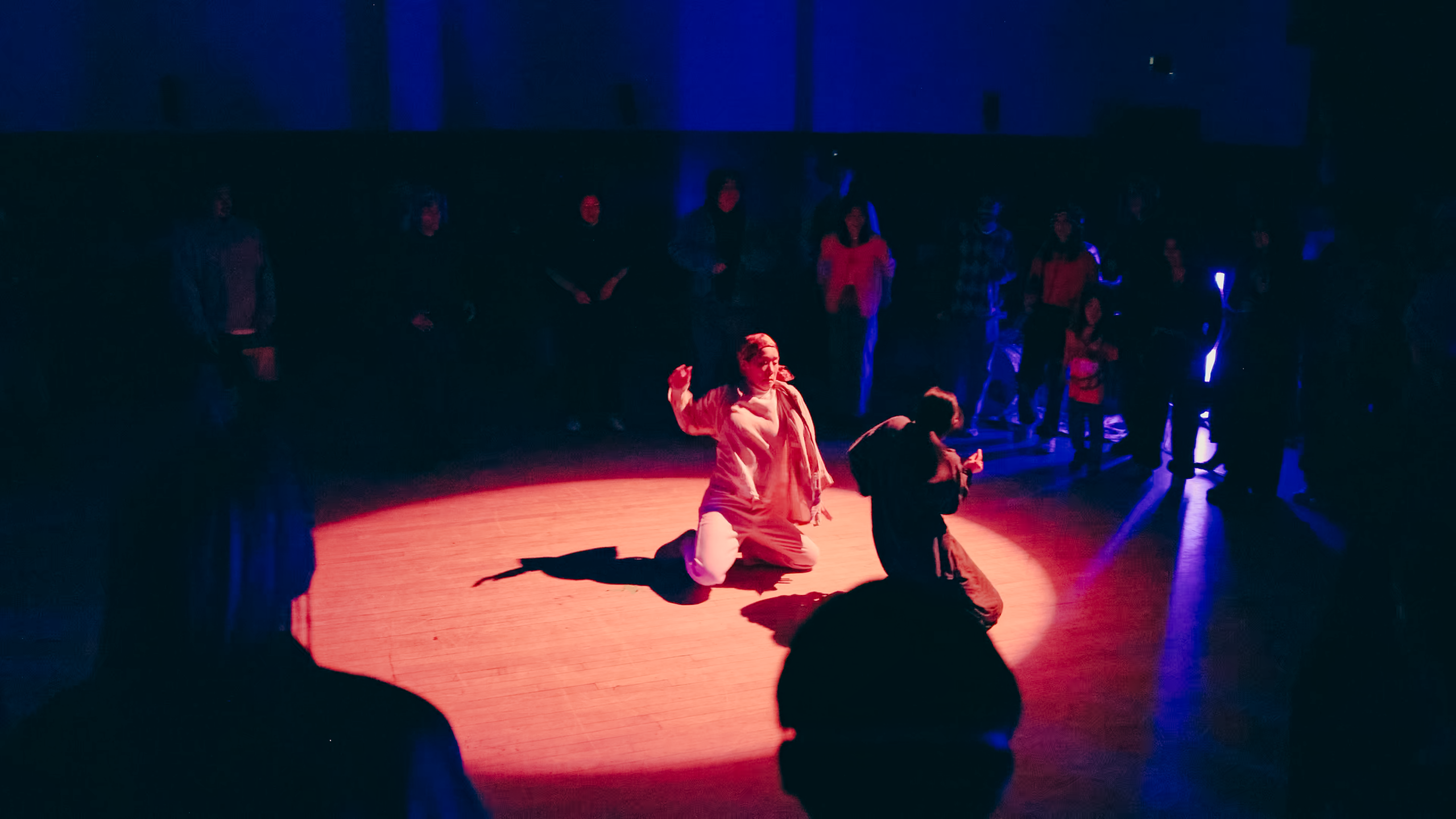
In a darkened room set in the round, the performance began with the soft sound of Miguel Maravilla’s clarinet. As the other musicians, Marty Ndlovu and Jen Yakamovich, gently joined in, a series of vertical free standing lights softly began illuminating a spotlighted circle of floor space in the centre of the room. As the musicians played off one another, building a layered score of drums, clarinet, guitar and synths, four dancers gradually crept into the circle.
Over the next 45 minutes Jason Owin Galeos, Riko Hitrota, Joshua Ongcol and Monoko Shimada responded to the undulating sounds with fluid motions. Moving in rhythmic sync, the dancers riffed off each other’s movements, generating a work that was both improvised and highly responsive. Throughout the piece, the musicians and dancers organically took turns being highlighted amidst the collective; a looped riff or echoed gesture would become one thread in the thick fabric of sound and movement perpetually making and remaking itself. Mid-way through, the audience was encouraged to stand and invited to join in the cypher. After temporarily enveloping the viewers, the collective score retracted back to the original performers. Dancers and musicians continued to directly play off one another’s energy, fuelling the work until it closed as gently as it begun, the music and lights fading into darkness.
Performers
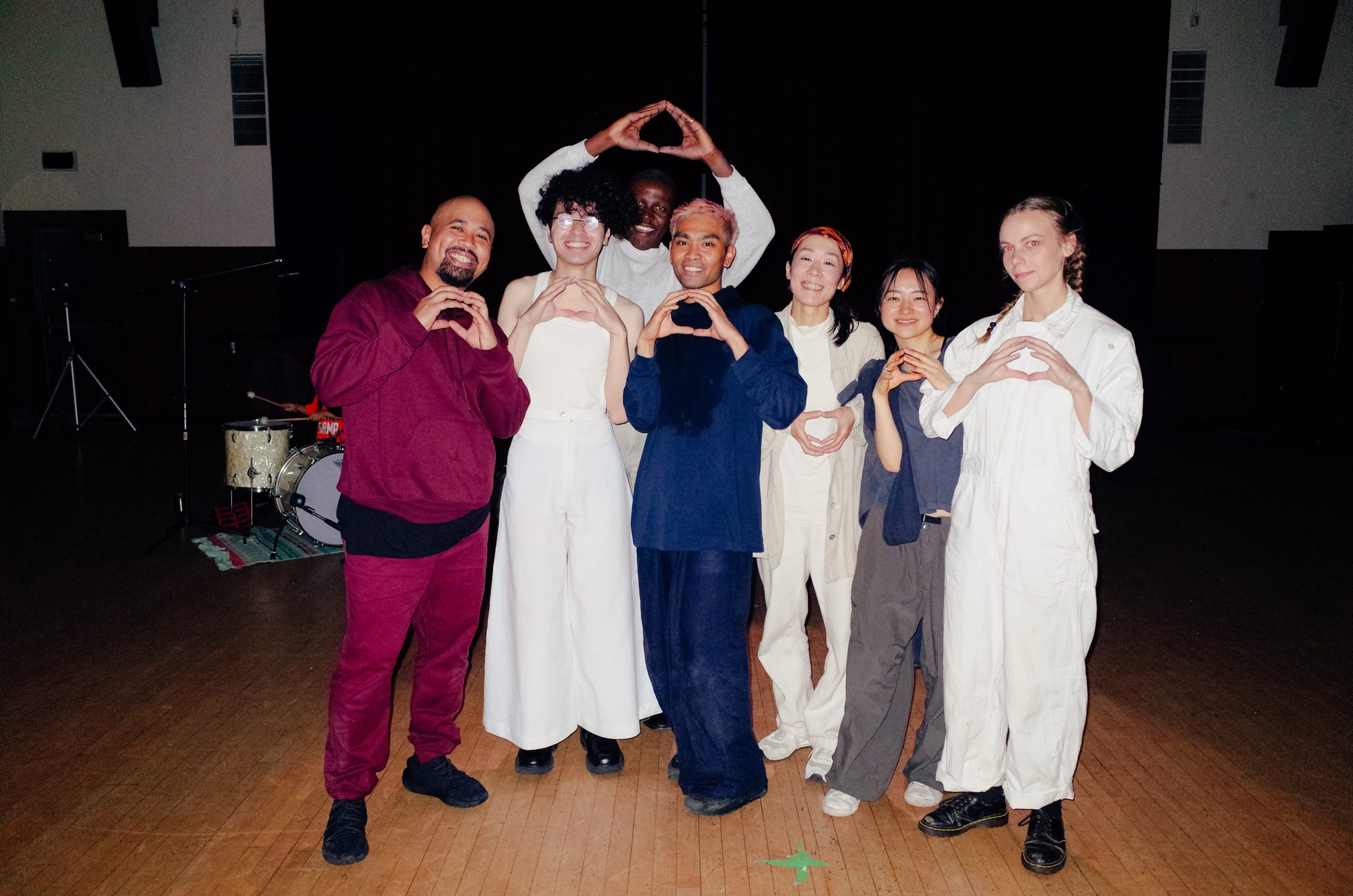
Jason Owin Galeos (Dancer), Riko Hirota (Dancer), Miguel Maravilla (Clarinet, Synths, Guitar), Marty Ndlovu (Synths, Percussion),Joshua Ongcol (Creative Director, Dancer), Momoko Shimada (Dancer), and Jen Yakamovich (Drums)
Interview with Joshua Ongcol
by Amy Ching-Yan Lam
December 2023
The circle as the fundamental form—the orbit of the earth, the inhale and exhale of breath, the symbol of absence or nothingness—is manifested in Joshua Ongcol’s dance performance The Energy Never Dies (The E.N.D.). Anchored by three musicians (Miguel Maravilla, Jen Yakamovich, and Marty Ndlovu) and four dancers (Joshua, Momoko Shimada, Jason Owin Galeos, and Riko Hirota), the hour-long performance takes the format of the dance cypher, a convention of street dancing in which dancers form a circle and take turns performing in the centre. In Ongcol’s performance, the cypher morphs and shifts with each relationship between the dancers, the musicians, and the audience. Different configurations of dancers move together in the centre, various relationships between musicians and dancers are explored, and at one point, the audience joins the cypher as well (and in that evening in October, with great joy and excitement). The circle is continually formed, deformed, and re-formed, asserting its eternal force.
I spoke with Joshua over Zoom in early December, 2023; this interview has been edited and condensed for length.
Amy Ching-Yan Lam: First of all, congratulations on the performance—I think the title was really made manifest in the energy that I felt that night. How did you develop this work, The Energy Never Dies? What was the beginning of it?
Joshua Ongcol: I was really inspired by freestyling, the cypher, and the skills that are required of freestyling: being receptive to music in the moment, and the people you’re dancing with, the settings. That’s my background of dancing, in street dance, whether it’s house, hip hop…I was working on a solo piece called Lakbay [Tagalog for “Journey”] before this, and I wanted to add collaborators and that’s when I started working with [musician] Miguel Maravilla. He’s a great improviser, he can play anything, and he’s Filipino. During that time we jammed a lot. That’s the beginning of it.
AL: How would you explain what a cypher is?
JO: To me, it’s a creative, energetic exchange between not only dancers—it can be rappers, spoken-word musicians—and it’s a constant back-and-forth, a call and response. It often forms a circle, and more people gather around. It can happen spontaneously, or it can be organized or intentional.
Cyphers are where the culture, or wherever we are, is expressing itself. So whatever comes through is a real-time action of it manifesting and expressing. We think together. Where the witnesses are also part of that energy exchange; they’re giving energy, responding, vocalizing.
AL: And how did you structure or shape The Energy Never Dies around the idea of the cypher?
JO: I’m interested in how cyphers can be a form of ritual—something energetic and spiritual. Some of the most powerful rounds I’ve had in the cypher was when it wasn’t really about me performing, but a connection to something powerful. Something powerful that includes me and everything and the universe.
I did a martial arts intensive, a Daoist immersion program, two summers ago that focussed on bagua [a Chinese martial art], taught by Lindsay Wei. She taught a pattern that involves a geometric shape, where you walk in a circle, in a figure 8. Every circle, you would count 1-2-3-4-5-6-7-8, and you always go back to the centre at 8, and from there you would spiral out of the circle and then spiral back in so that it completes itself. The intention was to activate the circle. And I was like, “wow.” It’s not a new idea. It’s a very modern and also a very ancient idea across cultures.
So I wanted to play with the limitation of those numbers, as well as freestyle around those numbers.
That circle [in the martial arts intensive] was only for one person. And I thought, what if we do it with four people, and we also do different patterns at the same time? We’re agreeing to this restriction, but what frees us—or what comes through—when we’re all in agreement to this thing?
And then also using strategies of opposition, synchronicity. We also played with making choreography, and using that as the structure that the musicians could freestyle in. We also played with the different instruments and how the different dancers would interpret the bass, or the drum, or the synth, or flute.
AL: It’s cool to hear about the patterns because I really saw that in the performance—it felt very intentional, but there was also this looseness about it. You could see the harmony of the overall shape, but also experience the freedom that the individual performers had. I wanted to ask you about the Daoism element, actually, because one of the reasons why I wanted to write about your performance came from an earlier description that Derrick [Chang, the director of LIVE] sent me, where you mentioned Daoist philosophy. I’ve been reading some Daoist texts this year, and they really resonate with me. Can you tell me more about that?
JO: When I was studying bagua, there was a routine—and there were many interesting reasons as to why we were moving in a certain way, but a lot of the movement qualities are circular, spiral, and in a way, it’s a groove. And in House [dance], a groove is also circular, always feedbacking from the earth to sky, always undulating through the spine.
The grooves of bagua are still connected to the earth, and this routine also was—and this is a quote from Lindsay—“You’re trying to replicate the movement of the universe through you.” You’re surveying the natural movement of the universe. And I was like, “whoa.” That gave me chills.
You’re connecting to the natural unfolding of things. Teaching your body to be receptive. There’s a healing quality to that. And I work in health care, I study massage therapy, so I’m interested in fascia. That’s also how the fascia likes to move, in spirals and circles, and it’s also where your qi runs—it’s through fascia. And so things clicked in three ways.
[The martial arts intensive] was good training in activating your internal world: we imagined a light growing from our dantian [chakras]; we did kung fu drills, and the discipline of doing something over and over felt like a really good foundation. In my fascia and how things are structured naturally—it gives a certain strength and alignment in my own body, but also a flow, a really clear flow. I was able to find a flow, as a dancer, through the influence of martial arts practice.
There’s a lot of similarities with house, where you’re always trying to go to a higher state, and higher rhythms. House is coming from West African cultures and it’s still connected to the earth, but it’s also trying to connect to something higher. And that’s the same thing in bagua, but through a different alchemy. I think that’s what was really interesting, seeing these different ways of expressing interconnectedness and the universality of energy.
AL: That’s really amazing. Maybe now’s a good time to ask, then, about your background as a dancer—how did you come to dancing as your primary practice?
JO: I started in high school; it came to me at a time when I just needed it. It was a really good way for me to express myself. At that time I was bullied a lot, I was also coming out. A lot of things were happening at the same time. It was also a time when America’s Best Dance Crew was on YouTube, and there were Filipino choreographers, Asian choreographers, I was seeing myself represented. That really emboldened me. It felt like I was able to express things that I didn’t have words for. It really validated my experiences through the discovery of my own body.
And so from there, I did high school dance, competitions, choreography. After that I pursued learning more about street dance culture, participating in battles, jams, and traveling to learn different forms of street dance. I still do it now, in House and in Vogue.
I went to contemporary dance school after high school and learned about different ways of creating dance works. Recently I’ve been doing a lot of solo work, with Dance West Network and Rumble Theatre. I still continue to learn…Now, I’m interested in exploring the communal aspects of dance—how that’s actually the soul of the dance form.
AL: There’s a line in your bio that stuck with me, that says, “As an artist, I’m interested in the ways tenderness manifests in my body.” Can you talk a bit more about that?
JO: I always want to, ideally, work from a receptive place. I find that the more I work with my own vulnerabilities and tenderness, the more I can respond…As an artist, whatever you’re feeling, or carrying, a difficult feeling—that’s what is coming out, and that’s what is just as important as the grander scheme of things.
My relationship to art is like: how sensitive am I to the nuances of the tensions of my own body? How do I hold that, with care, and even if I can’t—how do I find a community that can witness me and hold that space for me?
I really find that tenderness and vulnerable tension in your body is where the transformation, where the really loaded information, is. It has really big potential: not just for your own healing and wisdom, but that you can share with others.
So I think it’s two parts: How do I listen and hold it without numbing myself, or forcing it to come out, but hold it in its own time? So I’m constantly listening and responding to it. And then also, who am I holding it with—whether it’s with another person, or in nature—who else is witnessing, helping? Or who else is it connected with?
In massage therapy, you don’t want to push too hard on a knot that you find, because you’ll actually bruise it…You want to just meet it, to facilitate its own unfolding. And only then will it release. But you also don’t want to go too light, because then you’re going to miss it. And I feel like that’s a metaphor for making art too.
I believe my own healing is connected to my community’s healing as well. And that’s the art that I want to make.
AL: Yes, I love that idea, that you have to just meet the tension or the problem, not too hard or not too light, you have to just meet it.
JO: Yeah, by just meeting it—you don’t miss out on the nuances of it. If you force it, maybe you’re forcing your own ideas on it. You could be like, “Well, I actually don’t know what this is, and you tell me, let’s have this conversation. And that might actually change my outlook on it.” As opposed to, “This is what I think it is, I’m going to push through this way.” It might cause more harm, or it’s just your own idea. Your idea is something you already know.