
October. 12th 2023
The Polygon Gallery
7:00pm
Multong Bakla: A Silent Presence of Beauty is a divine communal summoning of queer Filipina/o/x spirits, exploring enigmatic connections which transcend distance and time. Coordinated by Zeus Bascon and Jordan Baylon, and inspired by two community-building artist workshops hosted in the Philippines and Canada, this showcase of light, sound, movement and poetry connects with supernatural and physical bodies between both locations.
Description
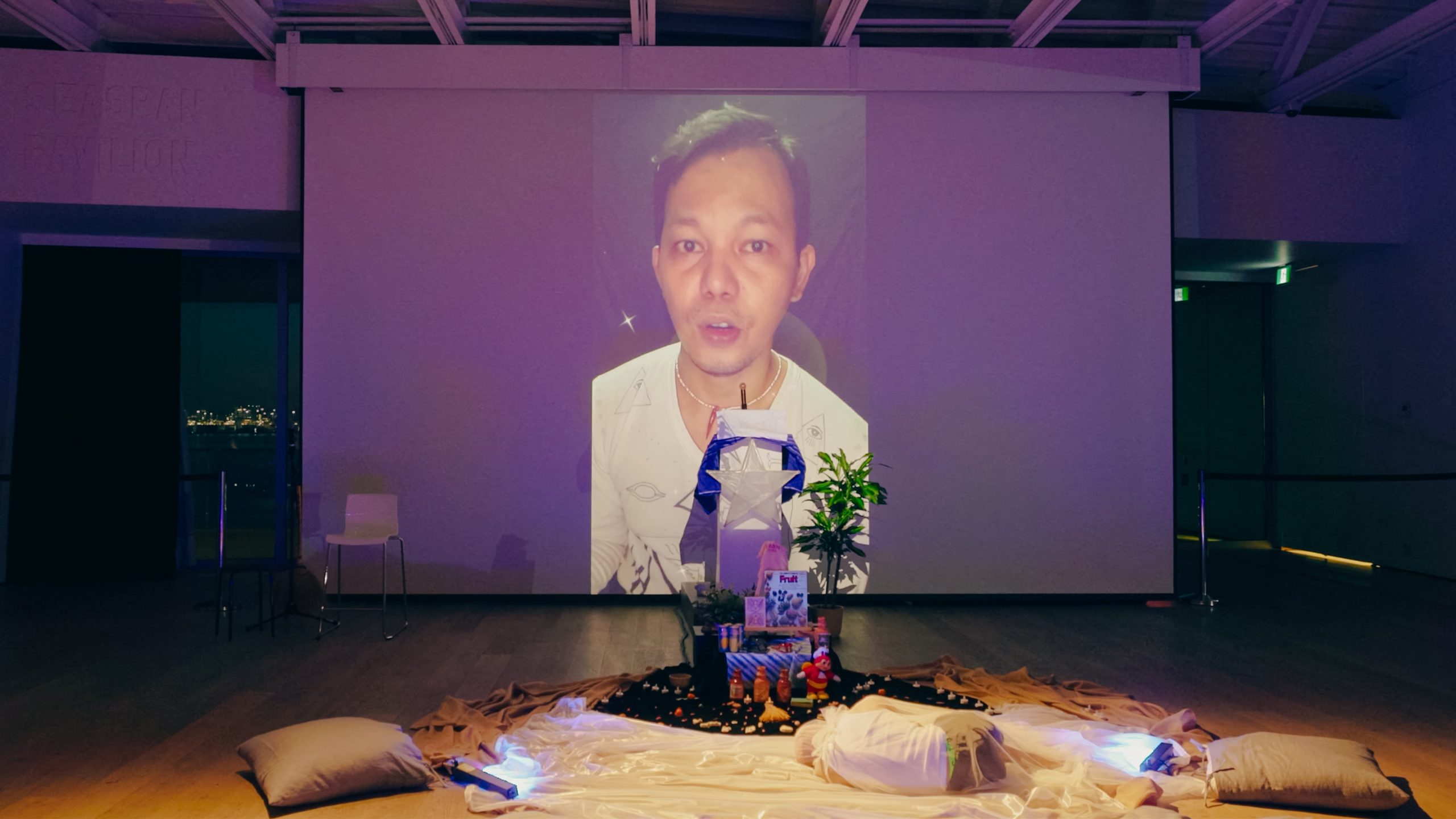
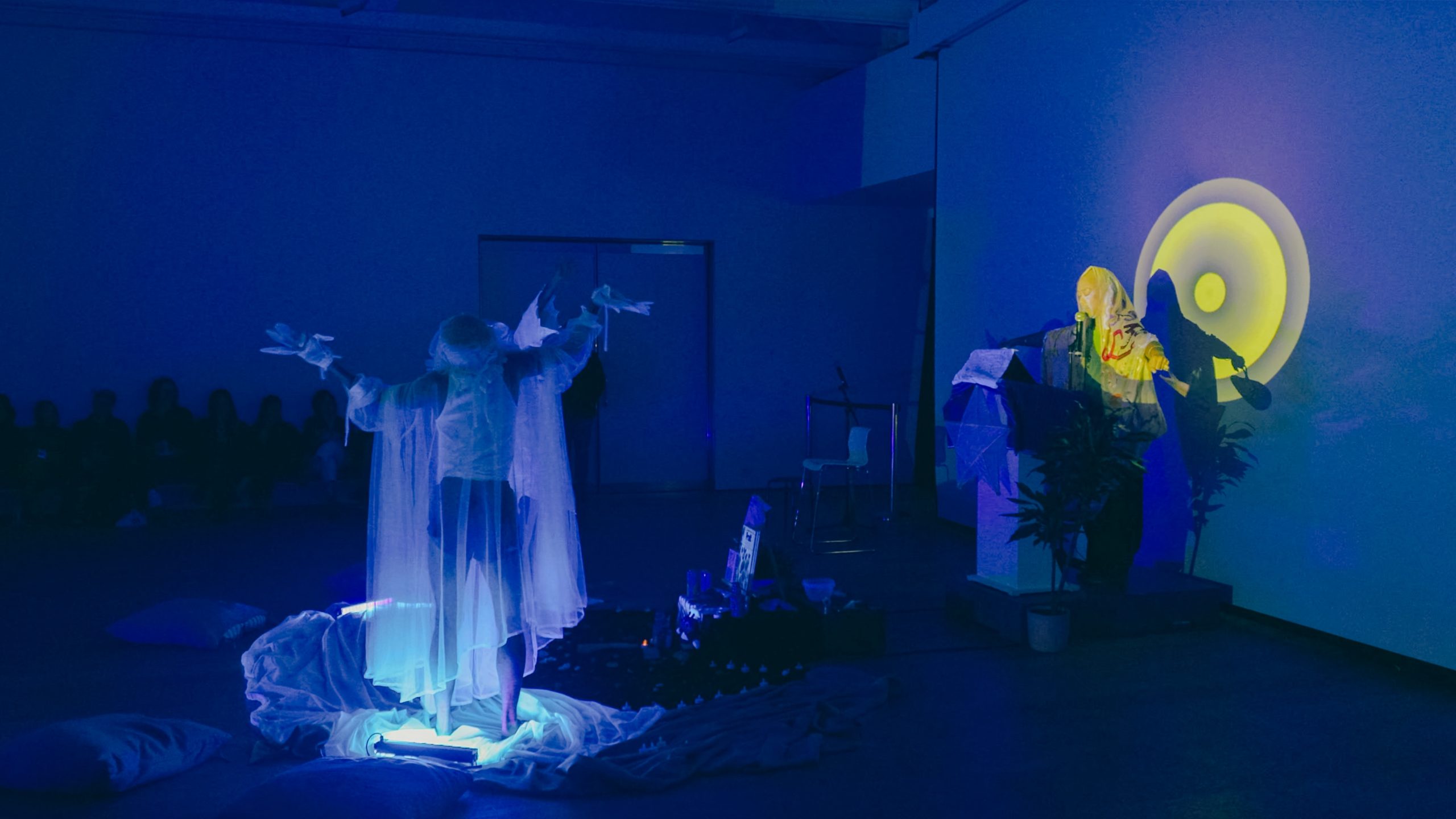
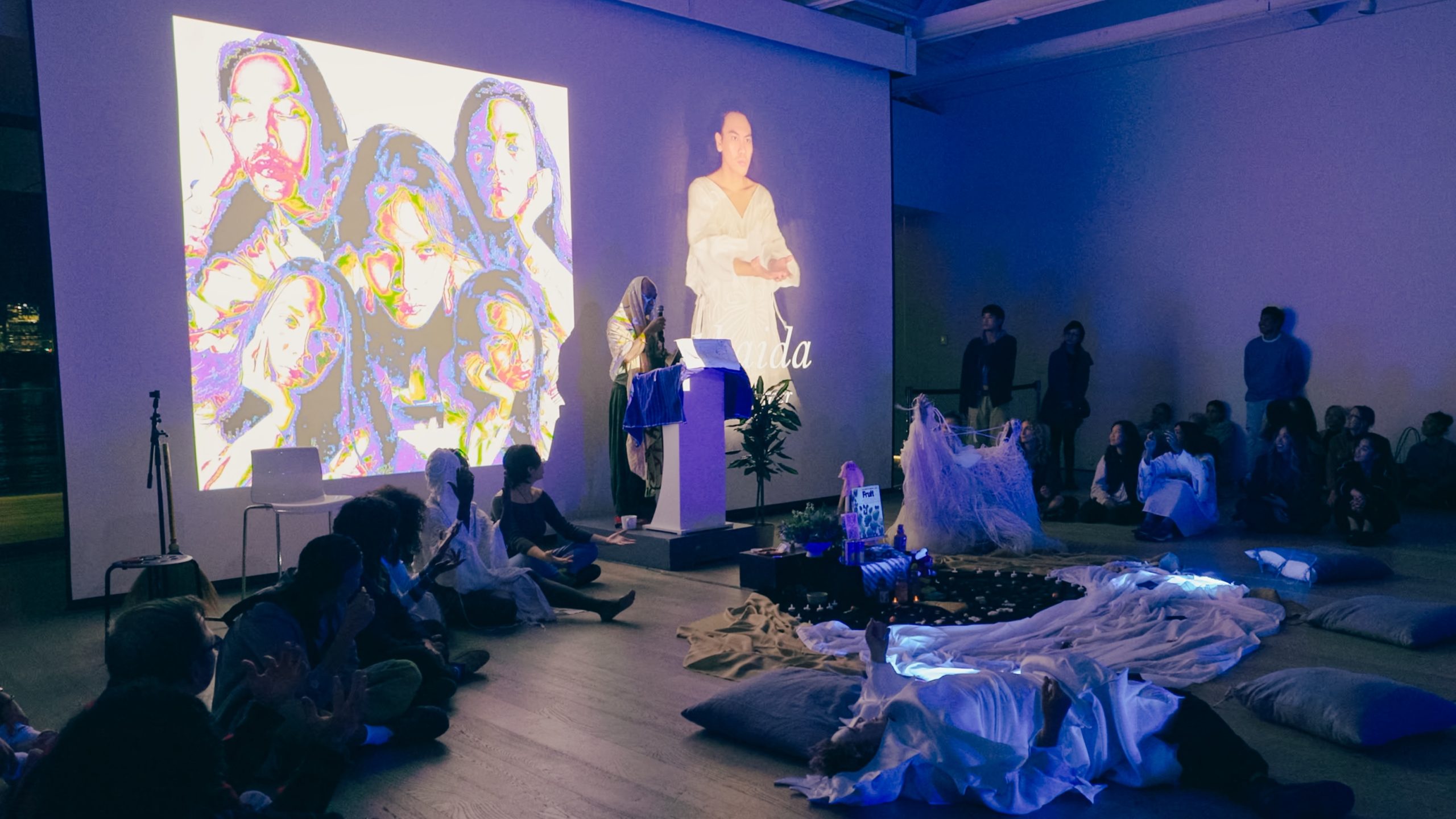
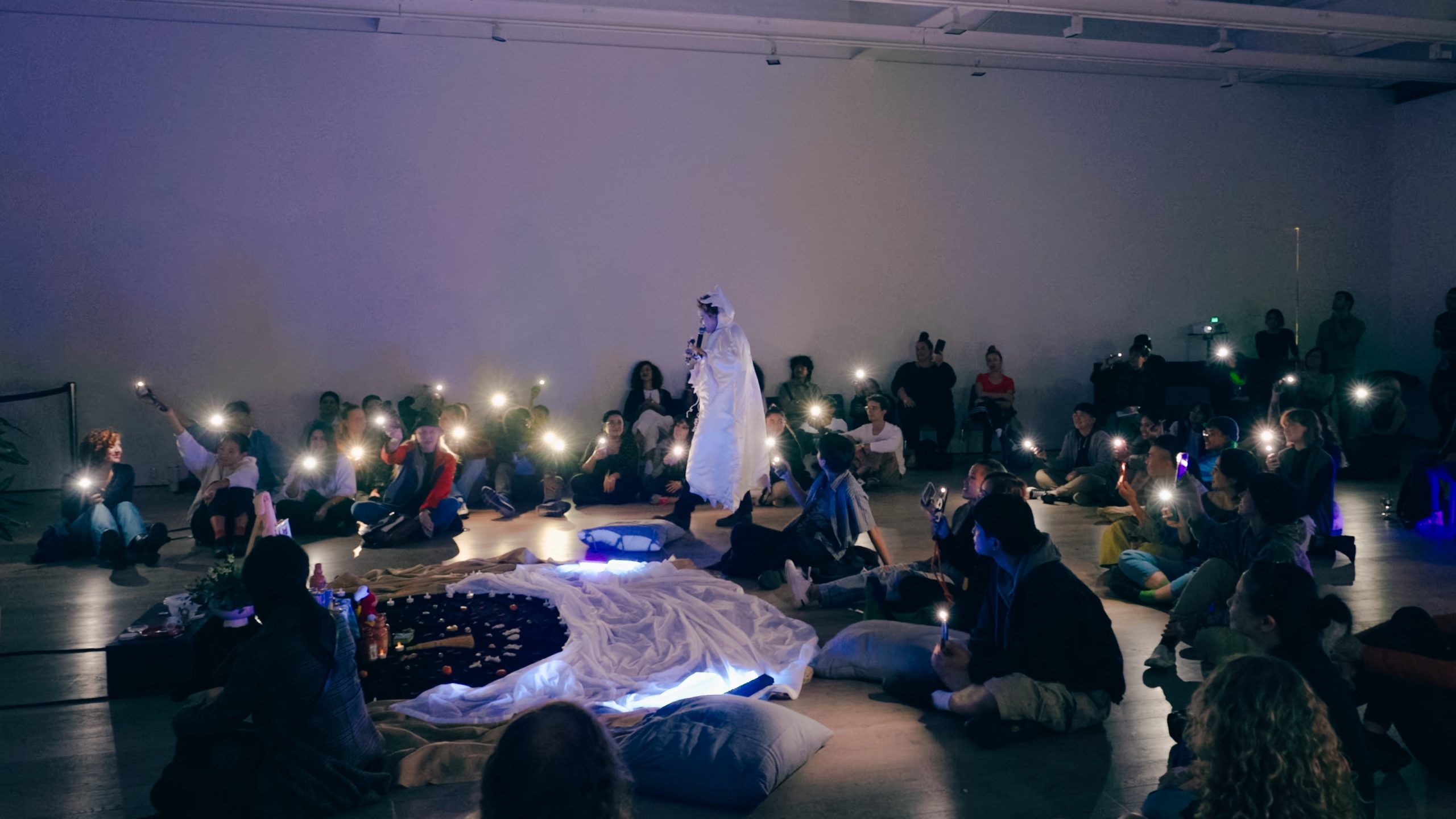
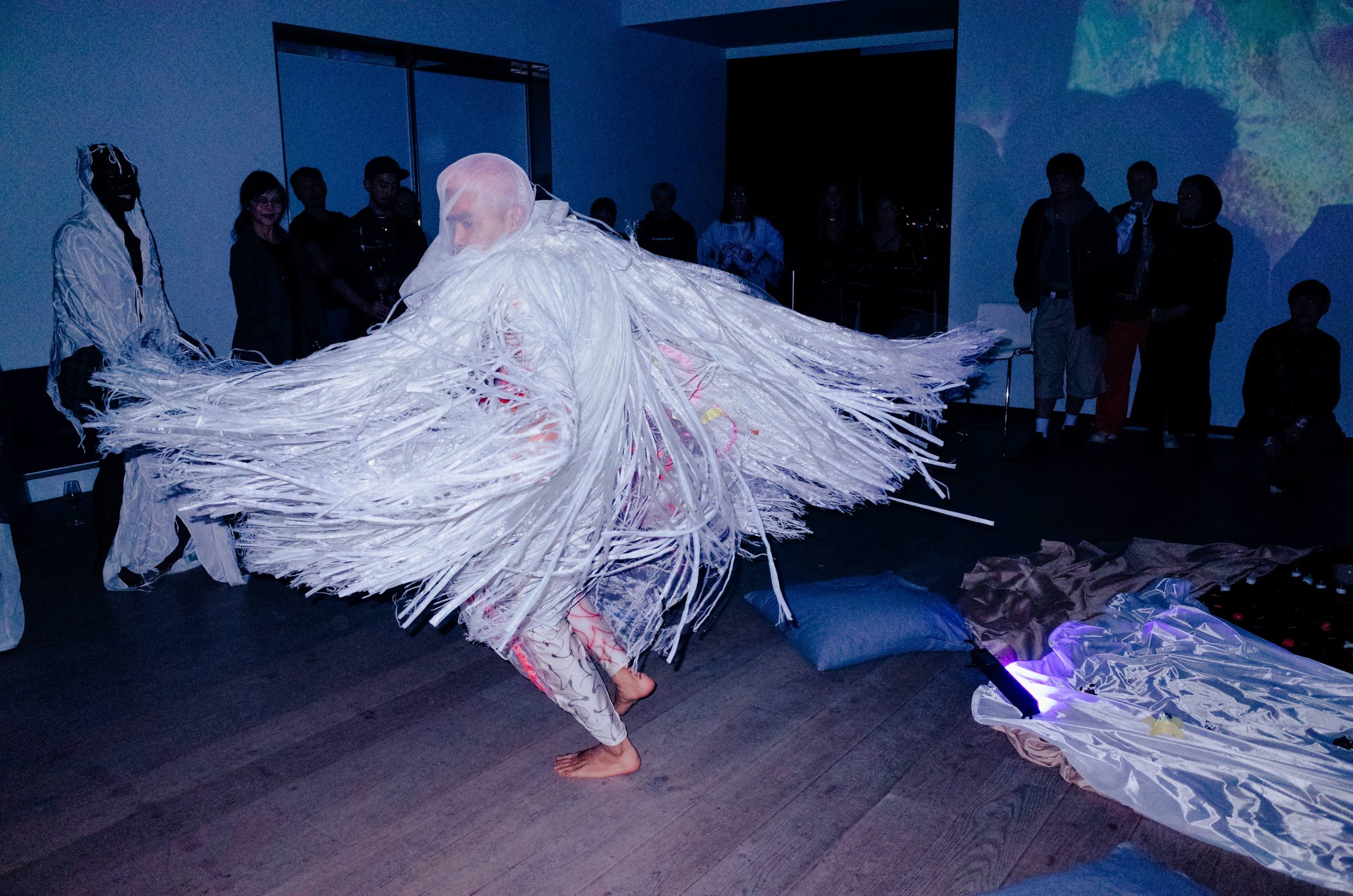
Multong Bakla began softly, as Jordan Baylon, dressed in a delicately decorated hooded shawl, called the audience into the dimly lit room, settling everyone in a circle around the podium from which they spoke. In front of the other-worldly projected performances by the participating artists based in the Philippines, Baylon poetically narrated an embodied tale haunted with colonial influences. They describe their complicated relationship to Inglis—a characterized alter-ego of English named after its Tagalog translation—and its accompanying Eurocentric notions of superiority. Many elements of this performance incorporated Baybayin (or Alibata), a pre-colonial Philippine script, which the artists reclaimed as a tool for queer Filipina/o/x peoples to connect to their histories through this work of gesture-making, choreography and composition. As performers Joshua Ongcol and Eris Fitz-James wove through the physical space, ethereal music and rippling light projections enveloped the room. Every performer, both in the space and on video, wore light, flowy costumes designed by Zeus Bascon. Pao Vergara notes in his article “Hauntingly beautiful: Manifesting queer beauty through reclaimed narratives in Zeus Bascon’s Multong Bakla,”these delicate spectral outfits were made by Bascon and his neighbours Ate Leony Baltazar and Ate Zaira Seanz, after conducting silk research and sourcing handwoven cotton-silk from JAF Handicraft and Piña Industry in Kalibo, Philipines.
This 90-minute trans-pacific collaboration unfolded in many segments, including a comedic intermission by Fitz-James and multiple ghostly dances by Ongcol, culminating in a participatory dance in the round. As Baylon sang, performers and audience members alike moved in a vortex, inscribing a circle on the void left in the wake of past and present colonial violence(s).
Performers
Zeus Bascon (Performer, Costume designer, Choreographer), Jordan Baylon (Poetry), Eris Fitz-James (Comedy), Jose Macasinag (Live projection), Manikween (Performer), Joshua Ongcol (Dance), Althea Pagdagdagan (Vocals), Gabe Tiano (Music), and 1haida (Performer)
Review of Zeus Bascon and Jordan Baylon’s
Multong Bakla: A Silent Presence of Beauty
by SF Ho
December 2023
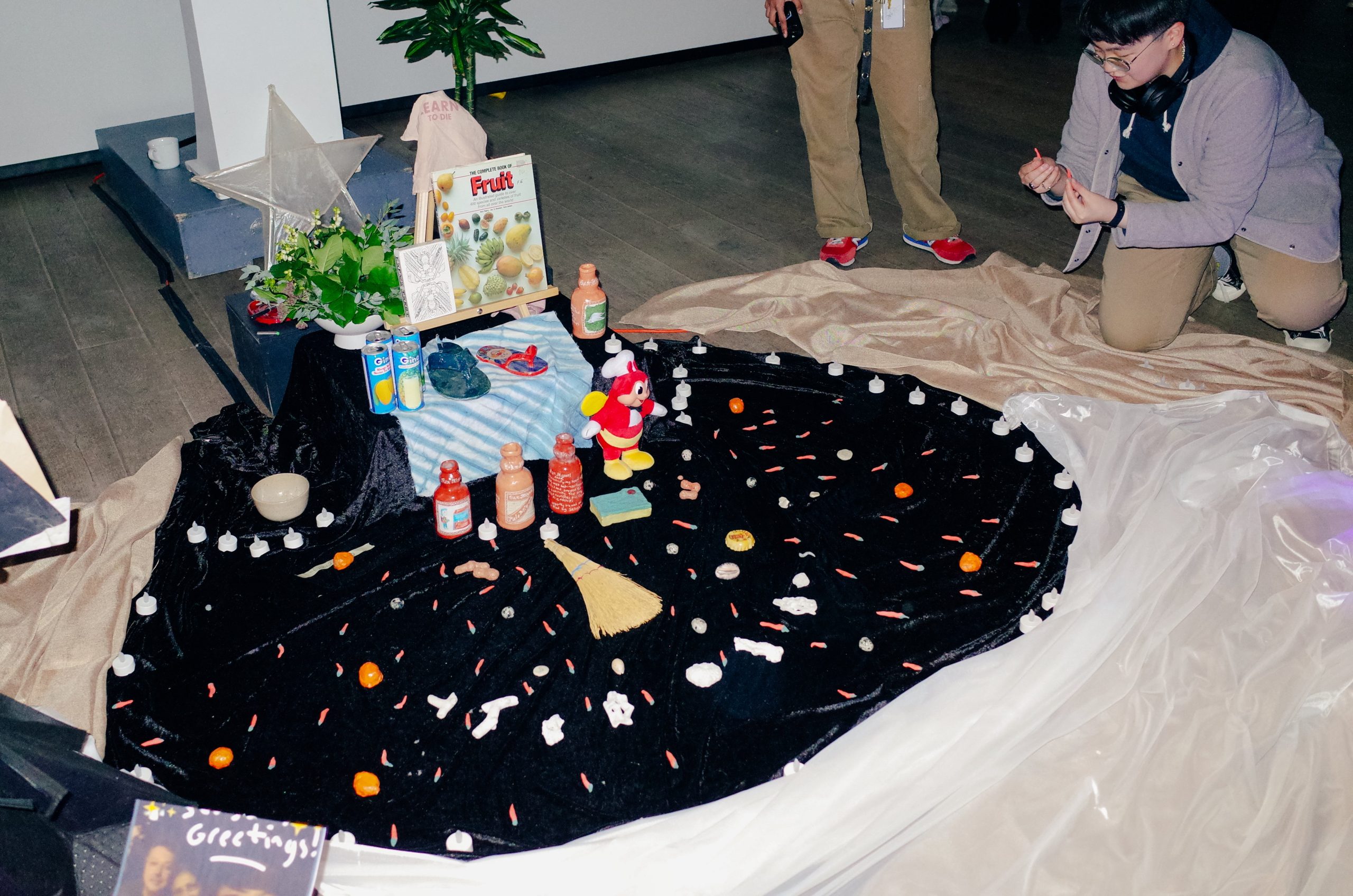
A shrine of white spreads itself out on the floor of the gallery. I approach this altar and notice little electric tea lights and a plush Jollibee mascot mixed with various offerings, some “real,” some lovingly reproduced in plasticine and clay: chilli peppers, coral, a broom, peanuts, cans of Gina mango juice, squat brown beer bottles, a sponge, a sandal. Placed in front of an empty lectern, a copy of The Complete Book of Fruit is transformed into a sacred icon displayed next to a deck of Kapwa tarot cards.
This is the setting for a cyclical journey, a homo/morphic haunting. Multong Bakla: A Silent Presence of Beauty is an unwieldy gathering born out of a series of community-building workshops between queer Filipino artists in the Philippines and so-called Canada. Coordinated by Zeus Bascon and Jordan Baylon, these workshops—including participants Alaga, Keith Boniol, Alicia Buates-McKenzie, Ethan Dailo, Fiona Cardino, Lanice Chep, Mark Cunanan, Lawrence Manuel, Tet Millare, Pette Shabu, Tiffany Thomas and Olive Villanueva—laid the relational foundation for the work we are about to witness. Tonight’s performance for LIVE Biennale features Manikween, 1haida, Althea Pagdagdagan, and Gabe Tiano in the Philippines and Eris Fitz-James, Jose Macasinag, and Joshua Ongcol on Turtle Island. With some workshop participants present in the space and some at a distance, we are offered a glimpse into a collective process that intentionally hovers somewhere in between the scrappy and spiritual.
A non-binary Tita shuffle-swaggers to the pulpit and begins a circuitous sermon, summoning the powers of oceanic rhythms and queer camp to draw us into a speculative territory situated in stark opposition to the forces of capital. “Be Here Now…” Tita invokes and repeats, “Be Here Now”. Calling upon Saint Octavia, they cast a divine circle. They ask, “Is there anything you want to compost?” Audience members shout back their replies—phone bills, Canada Day, the police. In a dance of call and response, we are gently drawn into a swirl of activity that is part show-and-tell, part mystic congregation, and part queer dance party. Calling on earth, sea and stars, Tita Baylon asks us, “Who here feels possessed by the land?” What emerges can only be described through a series of impressions strung out in dreamlike, non-linear form.
“Tututututututu…” Language flows across mediums, clumping and accumulating around us before breaking apart into syllabic chants, “Tututututututu.” Projected above us, delicate drawings inspired by Baybayin script evoke the trail of a spectre or a sea snake. I find myself compelled to queue in a line, while one after another we are anointed with a smear of white pigment. I look down and find a symbol has appeared on the back of my hand. Language forms into movement and ritual, while these movements and rituals also work to reclaim the tongue. Bodies echo fronds of seaweed or branches of coral swaying in ocean currents, echo the forms of apparitions that dance upon a projected screen. Permeating our experience, phrases in Tagalog and a familiar language that Tita calls Inglis materialize in sight, sound, and haptic forms.
Isang Bagay
Isang Sisidlan
Isang Sugo
Isang Dayuhan
Isang Kalikasan
As the colonial language that Tita Baylon cheekily describes as “a toxic codependent relationship” transmogrifies into Inglis—its Tagalog translation, the Eurocentric cultural category known as “whiteness” also subtly undergoes a corresponding shift. The white of the altar and the white on the back of my hand blend into a halo of gesture and ornament, also white. Handmade white costumes adorned with fringe, tassels, and spikes evoke butterflies, polyps, and ghostly creatures found at the bottom of the sea. White becomes expansive and plural. The whiteness of the page, the textbooks, visas, overseas foreign worker permits, and all documents of bureaucracy decompose into a mushy pulp immersed in a realm of spectres.
There is a continuous sense of play here, sometimes taking on the feel of an impromptu runway or talent show. The goofiness reaches its pinnacle in a comedy set where a jovially boisterous, spiky-haired Eris dressed in a white costume shaped with matching couture spikes shares diaristic confessions of their gender euphoria journey, earnest implorations to consider Indigenous peoples affected by the wildfires in Lytton, and a karaoke version of “My Way” (fortunately, no one died), while lit by the audience’s cellphone flashlights and a chunky, baby-faced sun. A trans flag is projected in the background as Sinatra’s words ring through the air, an anthem for queer bodies to release their shame.
An ethereal sea urchin beckons us into movement, furiously swirls, convulses, and drops to the floor while we cheer him on. The creature is a blur of luminescence and grace. We follow him in a circle, spiraling deeper through more simple invitations toward movement and engagement. With my painted hand, I point the light from my cellphone towards the altar. People join hands. We clap together, a cult happy in the ethereal world that we have found together. Tita asks us to touch the surface of something quantum, ephemeral. I close my eyes, hold the palm of my hand against the surface of a particle and feel myself vacillating between states of participant, audience, and spirit.
Euphoria propels me into a swaying crowd where I catch the eye of a friend across the room. I realize that, more than passively watching performance art, what I really want to do is dance with the people I love, a simple act that still feels especially precious after years of pandemic isolation. After the manifold, elaborate permutations experienced throughout the evening, to find myself in this simple place, to simply “be here,” in this moment, is more than enough. “Be Here Now…” Moving in a circle, we end as we began. This quiet incantation sounds across the space while laughing spectres, simultaneously distant and present, whisper ghostly songs into the future.